
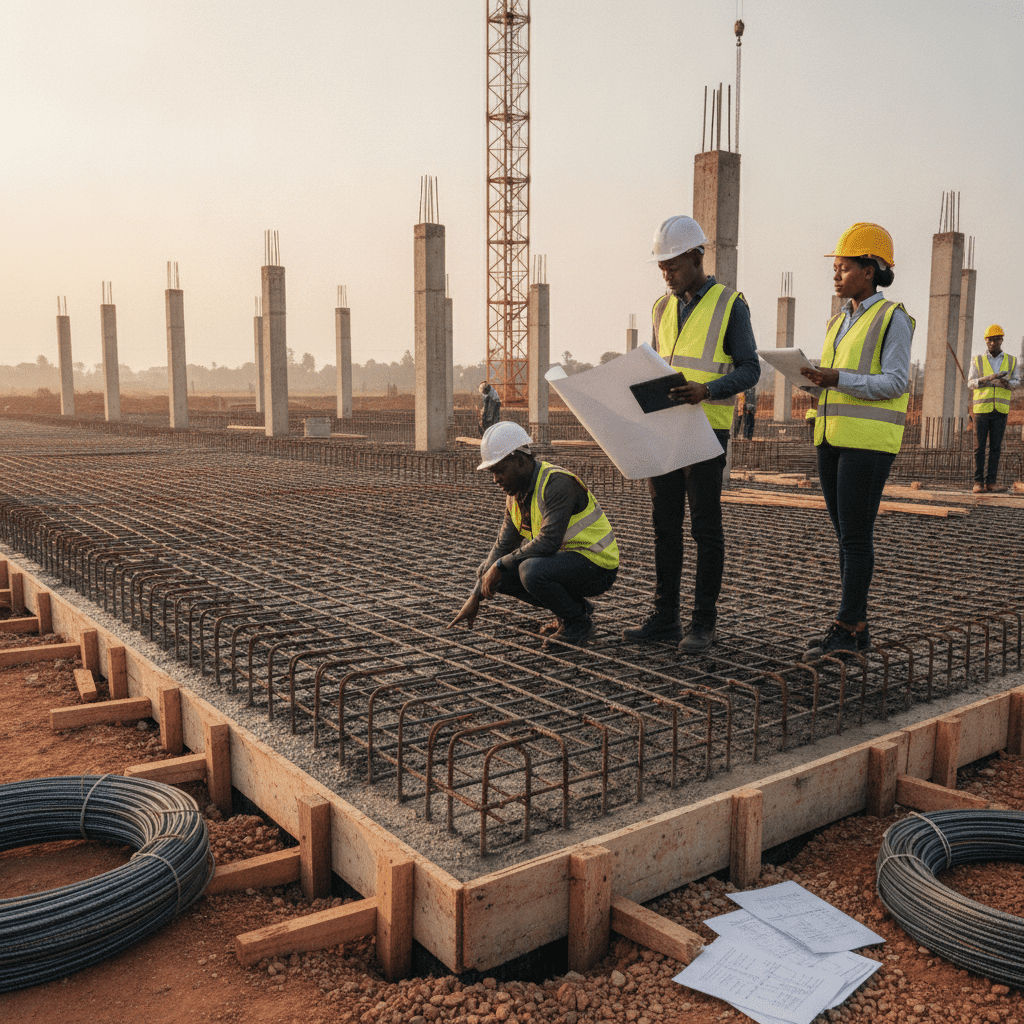
Raft Foundation Design: Kenya’s Solution for Challenging Soils
Kenya’s diverse geological landscape presents unique challenges for construction, particularly when it comes to foundation engineering. From expansive black cotton soils to low-bearing capacity silts, selecting the appropriate foundation is paramount to a structure’s stability and longevity. When conventional shallow foundations or isolated pad footings prove inadequate, the raft foundation emerges as a robust and often indispensable solution, distributing structural loads over a wide area to mitigate settlement and ensure structural integrity.
Understanding Raft Foundations in the Kenyan Context
A raft foundation, also known as a mat foundation, is essentially a large concrete slab that covers the entire footprint of a building, or a significant portion of it. Unlike isolated footings that support individual columns, a raft foundation acts as a single, continuous unit, transferring the total load of the structure uniformly to the underlying soil. This engineering principle is particularly critical in Kenya where specific soil conditions demand a more distributed load transfer mechanism.
In regions like Nairobi, especially areas such as Ruaka, Kitengela, and parts of Ongata Rongai, expansive black cotton soils are prevalent. These soils exhibit significant volume changes with varying moisture content, swelling when wet and shrinking when dry. This cyclic movement can induce severe differential settlement and structural damage if not properly addressed by the foundation design. A raft foundation, by spreading the load over a larger area, effectively reduces the pressure on the soil, making it less susceptible to the effects of localized soil movements. Furthermore, its monolithic nature provides inherent stiffness, bridging over localized weak spots or pockets of swelling soil, thus minimizing differential settlement across the structure.
Along the Kenyan coast, in counties like Mombasa and Kwale, construction often encounters soft silts, loose sands, and high groundwater tables. These conditions result in soils with very low bearing capacity, making traditional shallow foundations prone to excessive settlement. A raft foundation significantly increases the contact area with the soil, thereby reducing the stress intensity and allowing the foundation to “float” on weaker strata. This design also provides a robust barrier against groundwater ingress, which is a critical consideration in coastal environments where saline water can accelerate concrete degradation and steel corrosion.
For projects located on reclaimed land or areas with varied subsurface conditions, such as infill in Kisumu near Lake Victoria, a raft foundation offers a practical solution. The inherent variability in such ground conditions often leads to unpredictable settlement patterns with isolated footings. A raft foundation effectively averages out these variations, providing a more uniform response and reducing the risk of localized failures. Cadreatech’s expertise in Foundation Types in Kenya — Which is Right for Your Project ensures that the most suitable and cost-effective foundation is selected, considering all site-specific geotechnical and structural requirements.
| Common Raft Foundation Design Pitfalls | Mitigation Strategy |
|---|---|
| Inadequate Geotechnical Investigation | Comprehensive bearing capacity evaluation and detailed soil profiling are essential for informed design decisions. |
| Under-reinforcement for Punching Shear | Meticulous shear design around columns with appropriate stirrups or shear caps to resist concentrated loads. |
| Ignoring Differential Settlement Potential | Incorporating stiffening beams, varying raft thickness, or implementing ground improvement techniques. |
| Lack of Proper Waterproofing | Utilising robust bentonite sheets, crystalline admixtures, or high-performance membrane systems, especially in wet areas. |
| Non-compliance with Local By-laws | Early engagement with county planning departments and ensuring design sign-off by a registered structural engineer. |
Geotechnical and Structural Design Principles for Raft Slabs
The successful design of a raft foundation in Kenya hinges on a symbiotic relationship between thorough geotechnical investigation and meticulous structural engineering. Without accurate subsurface data, even the most sophisticated structural analysis can lead to inadequate or over-conservative designs. The process typically begins with a comprehensive site investigation, involving borehole drilling, Standard Penetration Tests (SPT), Cone Penetration Tests (CPT), and laboratory analysis of soil samples to determine crucial parameters such as soil stratification, groundwater table depth, shear strength, compressibility, and swelling potential. For expansive soils, tests like the Atterberg limits and free swell index are indispensable.
Based on the geotechnical report, engineers derive critical design inputs: the allowable bearing pressure, modulus of subgrade reaction (k_s), and expected total and differential settlements. The modulus of subgrade reaction is particularly important as it represents the soil’s stiffness and its interaction with the raft, which is often modelled as a plate on an elastic foundation. Structural design then treats the raft as an inverted floor slab, subjected to upward soil pressure and downward column/wall loads. The analysis typically involves finite element methods (FEM) to accurately predict bending moments, shear forces, and deflections across the entire slab. This allows for precise reinforcement detailing, ensuring the raft can withstand both punching shear around columns and overall flexural demands.
Reinforcement detailing is a critical aspect. Raft slabs, especially those supporting multi-storey buildings, require robust top and bottom reinforcement grids to resist both positive and negative moments. Shear reinforcement, typically in the form of shear links or stirrups, is provided around columns to prevent punching shear failure. The concrete mix design is also paramount, with specified characteristic strengths (e.g., C25/30 or C30/37) and appropriate cover to reinforcement, particularly in aggressive environments like coastal areas where chloride ingress can lead to corrosion. Cadreatech places immense value on Professional Bearing Capacity Evaluation in Kenya for Safe Foundation Design, ensuring every design is underpinned by reliable soil mechanics principles.
Furthermore, considerations for construction joints, expansion joints, and the sequencing of concrete pours are integrated into the design to manage thermal stresses and minimize cracking. In areas with high groundwater, the design must also account for potential uplift pressures, often requiring additional dead load or a thickened slab section to counteract buoyancy. The final design drawings specify concrete grades, steel reinforcement sizes and spacing, cover to reinforcement, and construction details, all conforming to relevant Kenyan building codes and best engineering practices.
Designing a raft foundation in Kenya requires a systematic, multi-disciplinary approach, integrating geotechnical insights with structural engineering principles to ensure long-term stability and performance. At Cadreatech, our process is meticulously structured to navigate the unique challenges presented by Kenya’s diverse geology and climatic conditions, from the expansive black cotton soils of Kajiado to the corrosive coastal environments of Mombasa. We begin by understanding the proposed structure’s demands and the site’s inherent characteristics, recognizing that a generic solution is rarely sufficient for complex projects.
Our initial phase involves a comprehensive site reconnaissance and preliminary data collection. This includes reviewing existing topographical maps, geological surveys if available, and local development plans. We engage with clients to understand the building’s intended use, number of stories, anticipated loads (dead, live, wind, seismic), and any special requirements suchating heavy machinery or sensitive equipment. This foundational understanding is crucial before any technical investigations commence.
Following this, a detailed geotechnical investigation is commissioned. This is not merely a formality but the bedrock of a safe and economical raft design. It involves boreholes, trial pits, and in-situ tests to classify soil strata, determine groundwater levels, and establish critical engineering parameters. For instance, in areas with suspected expansive clays like parts of Nairobi and Kisumu, we conduct tests to quantify swell-shrink potential. For sites with poor bearing capacity, such as reclaimed land or soft alluvial deposits, the geotechnical report provides crucial data on consolidation characteristics and settlement predictions. Our engineers then conduct a thorough Professional Bearing Capacity Evaluation in Kenya for Safe Foundation Design to ascertain the soil’s ultimate and allowable bearing pressures, crucial for sizing the raft slab effectively.
The structural design phase then commences, leveraging advanced finite element analysis software to model the raft slab and the interacting soil. We consider the raft as a flexible plate resting on an elastic foundation, allowing for accurate distribution of loads and assessment of bending moments and shear forces. Reinforcement detailing adheres strictly to Kenyan building codes and international standards like BS 8110 or Eurocode 2, ensuring adequate steel provision for both flexural and punching shear requirements. Special attention is paid to edge beams, column pedestals, and openings within the raft, which are critical stress concentration points. For structures in seismic zones, the raft design incorporates ductility requirements and considers dynamic soil-structure interaction effects.
Our design deliverables typically include detailed foundation layouts, reinforcement schedules, bar bending schedules, and comprehensive design reports justifying all assumptions and calculations. We also provide construction specifications, outlining material quality, concrete mix designs, curing procedures, and excavation and backfilling requirements. This holistic approach ensures that the design is not only structurally sound but also practical and constructible on site, minimizing potential delays and cost overruns during the construction phase.
- Project Inception and Data Collection: Initial client consultation to define project scope, structural requirements, and site location. Review of any available historical site data, architectural drawings, and local planning regulations.
- Detailed Geotechnical Investigation: Commissioning of boreholes, trial pits, SPTs (Standard Penetration Tests), CPTs (Cone Penetration Tests), and laboratory tests (e.g., shear strength, consolidation, Atterberg limits) to characterize soil profiles, water table, and engineering properties.
- Geotechnical Analysis and Recommendations: Interpretation of geotechnical data to determine soil bearing capacity, settlement potential, liquefaction risk (if applicable), and specific foundation type recommendations. This forms the basis for structural design parameters.
- Preliminary Structural Design and Modelling: Development of initial raft dimensions based on column loads and allowable bearing pressure. Creation of a 3D finite element model of the raft and superstructure, simulating soil-structure interaction.
- Detailed Structural Analysis and Reinforcement Design: Performing comprehensive analysis for bending moments, shear forces, and deflections. Designing the required reinforcement (main bars, shear links, crack control) in accordance with relevant building codes (e.g., Kenya Building Code, Eurocodes).
- Construction Documentation and Specifications: Preparation of detailed engineering drawings including foundation layouts, reinforcement schedules, bar bending schedules, and cross-sections. Development of comprehensive construction specifications covering materials, concrete mix, formwork, and quality control procedures.
- Peer Review and Approval: Internal quality check and external peer review by a registered engineer where required, ensuring compliance with all regulatory requirements and best engineering practices.
- Construction Support and Supervision: Providing technical support during construction, including site visits for foundation inspections, material verification, and addressing any unforeseen site conditions or design queries.
The scope and complexity of raft foundation design in Kenya are highly variable, driven by a confluence of geological, environmental, structural, and regulatory factors. Understanding these drivers is essential for both developers and engineers to accurately scope projects, anticipate challenges, and ensure the delivery of a safe, compliant, and cost-effective foundation. Overlooking any of these critical elements can lead to significant structural deficiencies, construction delays, and unforeseen expenses.
One of the primary determinants is the subsurface soil condition. Kenya’s geology is incredibly diverse, presenting unique challenges across different regions. In Nairobi and parts of Kajiado, expansive black cotton soils are prevalent. These soils undergo significant volume changes with moisture content fluctuations, leading to differential settlement and potential structural damage if not properly managed. Raft foundations in such areas require careful consideration of under-reaming, void former installation, or ground improvement techniques to mitigate swell-shrink pressures. Conversely, coastal areas like Mombasa and Kilifi often feature soft, compressible marine clays or loose sands with high groundwater tables. Here, the design must account for consolidation settlement, liquefaction potential during seismic events, and the corrosive effects of saline groundwater on concrete and reinforcement. The required depth of investigation and the complexity of soil modelling will directly impact the design scope.
The type and magnitude of the superstructure loads are equally critical. A low-rise residential building will impose significantly different demands on a raft foundation compared to a multi-story commercial tower or an industrial facility housing heavy machinery. High-rise buildings, especially, demand meticulous attention to total and differential settlement predictions, as even minor variations can induce stresses in the superstructure. The distribution of column loads, the presence of shear walls, and the overall structural system dictate the raft’s thickness, stiffness, and reinforcement density. For structures with highly concentrated loads, localized thickening or additional deep beams within the raft may be necessary.
Seismic activity is another non-negotiable factor. While Kenya is not on a major fault line, certain regions, particularly along the Great Rift Valley (e.g., parts of Nakuru, Kisumu), experience seismic tremors that necessitate specific design considerations. Raft foundations in these zones must be designed to resist lateral forces and accommodate potential ground movements without catastrophic failure. This involves ensuring adequate ductility, robust connection details between the raft and the superstructure, and, in some cases, dynamic analysis to assess the raft’s response to earthquake loading.
The groundwater table plays a crucial role, particularly in low-lying areas or near water bodies like Lake Victoria in Kisumu. A high water table complicates excavation, necessitates dewatering during construction, and can exert hydrostatic uplift pressures on the raft. Furthermore, the chemical composition of groundwater, especially in coastal or industrial areas, can be aggressive to concrete and steel, requiring specialized concrete mixes (e.g., sulfate-resisting cement) and protective coatings for reinforcement. The need for a waterproof raft or a drainage system will significantly add to the design and construction scope.
Finally, site access and construction methodology also influence the design. A congested urban site in Nairobi’s CBD with limited space for excavation and material handling might necessitate a different raft design approach compared to an open field in Athi River. The choice of excavation equipment, the feasibility of deep excavations, and the method of concrete pouring (e.g., pump vs. crane and bucket) can all impact the practical aspects of the raft’s dimensions and detailing. When considering Foundation Types in Kenya — Which is Right for Your Project, it is critical to align the chosen solution with these practical site constraints.
While raft foundations offer a robust solution for challenging ground conditions, their successful implementation in Kenya is contingent on a meticulous approach to risk mitigation and strict adherence to regulatory compliance. Improper design or construction can lead to severe structural issues, ranging from unsightly cracks to catastrophic failure, endangering occupants and incurring significant financial losses.
One primary concern is differential settlement, particularly prevalent in areas with variable soil strata or highly compressible soils like the black cotton found in parts of Nairobi and Kajiado counties. If the raft settles unevenly, the superstructure experiences undue stress, leading to diagonal cracks in walls, distorted door frames, and compromised structural integrity. Engineers must design the raft with sufficient stiffness and consider ground improvement techniques where necessary to limit angular distortion to acceptable industry standards, often less than 1/500 for framed structures.
Another critical risk is punching shear failure, where concentrated column loads attempt to “punch” through the raft slab. This is a localised shear failure that occurs around columns or other concentrated load points. Adequate shear reinforcement, typically in the form of stirrups or specific shear-head detailing, must be meticulously calculated and provided within the critical perimeter to resist these forces. Overlooking this detail can lead to sudden and brittle failure, a significant safety hazard.
Warning: Ignoring Geotechnical Data is a Critical Error
Proceeding with raft foundation design without a comprehensive geotechnical investigation is one of the most dangerous shortcuts in construction. Without understanding the soil’s bearing capacity, stratification, and groundwater conditions, the foundation design becomes an educated guess, significantly elevating the risk of settlement, structural failure, and costly post-construction remedial works. Always insist on a professional Professional Bearing Capacity Evaluation in Kenya for Safe Foundation Design to inform your engineering decisions.
Water ingress poses another significant challenge, especially in high water table regions such as Kisumu along Lake Victoria or coastal areas like Mombasa. Persistent moisture can lead to the corrosion of reinforcement steel, commonly known as “concrete cancer,” compromising the concrete’s integrity and reducing the lifespan of the structure. Effective waterproofing systems, including robust membranes or crystalline admixtures, and careful consideration of drainage, are paramount in these environments.
Compliance with Kenya’s regulatory framework is non-negotiable. All structural designs, including raft foundations, must be prepared and signed off by a registered engineer in accordance with the Engineers Act 2011. Furthermore, county governments, such as Nairobi City County and Mombasa County, require the submission of detailed structural drawings, calculations, and geotechnical reports for approval before construction permits are issued. Adherence to the Building Code (Kenya Building Code 1968, supplemented by adopted international standards like Eurocodes or British Standards for modern detailing) ensures safety and structural integrity. Cadreatech ensures all designs meet or exceed these stringent local and international benchmarks.
| Design Input Parameter | Significance for Raft Foundation Design |
|---|---|
| Soil Type and Stratification | Determines the overall bearing capacity, potential for differential settlement, and suitability for raft construction. |
| Allowable Bearing Pressure | The maximum pressure the soil can safely sustain without excessive settlement or shear failure, directly influencing raft size. |
| Modulus of Subgrade Reaction (k_s) | Represents the soil’s stiffness, crucial for modelling soil-structure interaction in finite element analysis of the raft. |
| Groundwater Table Depth | Influences uplift pressures, concrete durability considerations, and the need for waterproofing or dewatering during construction. |
| Compressibility Characteristics | Predicts the magnitude and rate of consolidation settlement under sustained loading, vital for long-term performance. |
| Expansive Potential (e.g., black cotton) | Indicates susceptibility to volume changes due to moisture variation, necessitating specific design measures to mitigate heave or shrinkage. |
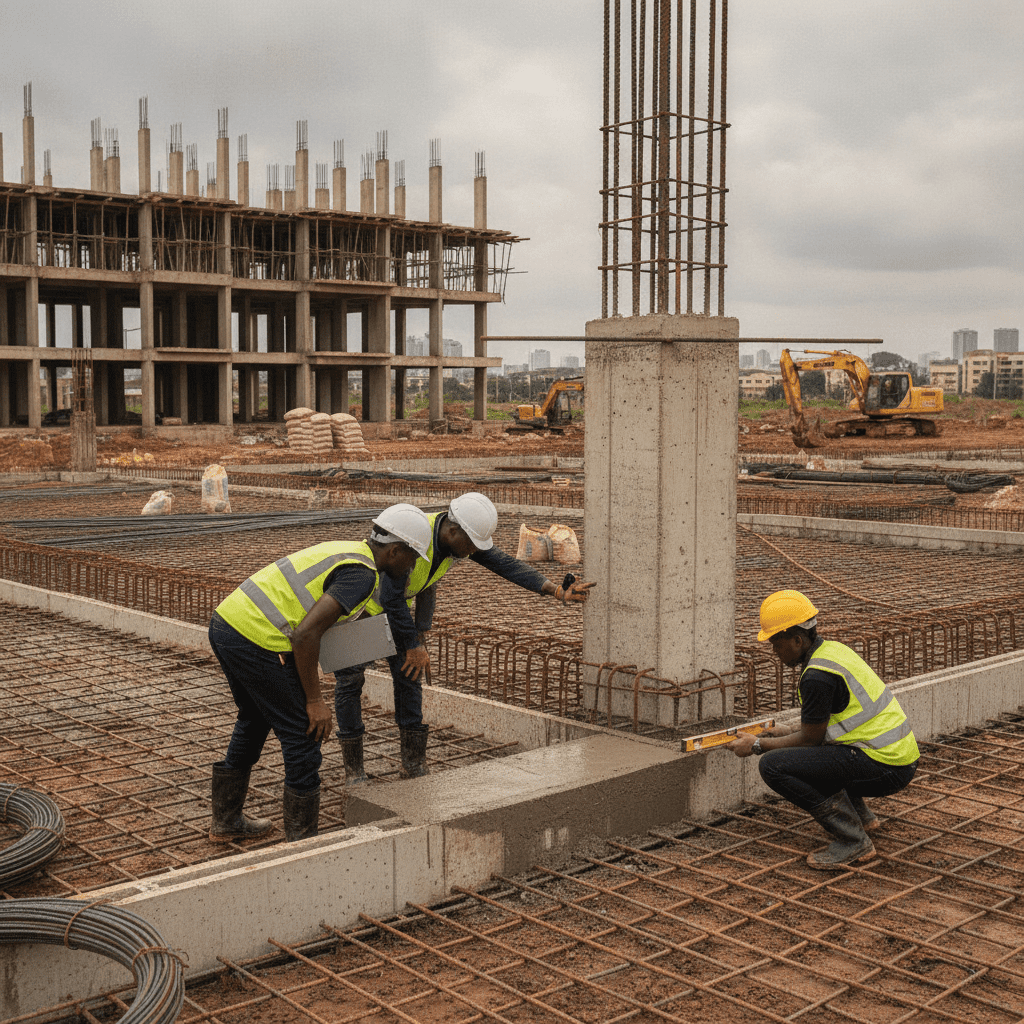
The Cadreatech Process for Robust Raft Foundation Design
Raft Foundation Design: A Step-by-Step Cadreatech Approach
| Factor | Impact on Raft Foundation Design Scope |
|---|---|
| Soil Type and Bearing Capacity | Determines raft thickness, reinforcement, and potential need for ground improvement or deep excavation. |
| Superstructure Loads | Influences overall raft dimensions, stiffness, and localized reinforcement for heavy column loads. |
| Groundwater Table | Dictates need for dewatering, waterproofing, and consideration of uplift pressures or corrosive effects. |
| Seismic Zone | Requires design for lateral forces, ductility, and potential dynamic analysis for earthquake resistance. |
| Site Accessibility | Affects construction methods, excavation feasibility, and practical limits on raft size and depth. |
Key Factors Influencing Raft Foundation Scope and Design in Kenya
Navigating Risks and Ensuring Compliance in Raft Foundation Projects
Engineer Note: The Value of Continuous Site Supervision
Even the most meticulously designed raft foundation can be compromised by poor construction practices. Continuous site supervision by a qualified structural engineer is crucial to ensure that excavation depths are correct, reinforcement is placed accurately, concrete is mixed and cured properly, and waterproofing systems are installed without defects. This oversight safeguards the design intent and ensures the long-term performance of the foundation.
Frequently Asked Questions
How does Cadreatech determine if a raft foundation is suitable for my project?
Cadreatech employs a rigorous, multi-stage assessment process to determine the optimal foundation type for your project. This begins with a comprehensive review of your architectural plans and the proposed structural loads. Crucially, we conduct or evaluate a thorough geotechnical investigation of your site to understand the soil’s bearing capacity, stratification, presence of expansive clays (like black cotton), and groundwater levels. We then compare the performance and economic viability of a raft foundation against other options, such as pad or piled foundations, considering factors like expected settlement, construction practicalities, and project timelines. Our recommendation is always data-driven and tailored to your specific site conditions and project requirements.
What are the key stages in a typical raft foundation design project with Cadreatech?
Our raft foundation design projects typically follow a structured methodology to ensure precision and compliance. It starts with an initial consultation and site reconnaissance, followed by a detailed geotechnical investigation. Based on this data, we undertake preliminary design calculations to establish the raft’s overall dimensions and thickness. The next stage involves detailed structural analysis and design, including reinforcement detailing for flexure, shear, and punching shear, considering all relevant load combinations and code requirements. Finally, we prepare comprehensive structural drawings and specifications, which are then submitted for statutory approvals. Cadreatech also offers construction supervision to ensure the design is implemented correctly on site.
What information do I need to provide Cadreatech to get a quotation for raft foundation design?
To provide you with an accurate and tailored quotation for raft foundation design, Cadreatech requires several key pieces of information. This includes the precise location of your project site, the proposed use of the building (e.g., residential, commercial, industrial), the number of floors, and any available architectural drawings or concept plans. If you have any existing geotechnical investigation reports for the site, these would be highly beneficial. Additionally, an indication of your project timeline helps us to scope the urgency and resource allocation. These details allow us to understand the complexity and scope of the engineering services required, enabling us to provide a comprehensive proposal without quoting specific money amounts.
How does a high water table affect raft foundation design in Kenya?
A high water table significantly impacts raft foundation design, particularly in regions like Kisumu, Mombasa, or low-lying areas of Nairobi. The primary concerns are uplift pressure (buoyancy), which can try to float the foundation, and the potential for water ingress into the structure. Cadreatech addresses this by designing the raft to resist uplift forces, possibly requiring additional weight or anchorage. During construction, effective dewatering strategies are crucial to maintain a dry excavation. We also specify robust waterproofing systems, such as tanking membranes or crystalline admixtures, and select appropriate concrete mixes (e.g., sulphate-resisting cement if groundwater is aggressive) to protect the concrete and reinforcement from long-term degradation. This meticulous approach ensures the foundation’s durability and the building’s stability.
Key Takeaways
- Strategic Foundation Choice: Raft foundations are a critical engineering solution in Kenya, particularly for sites with challenging soil conditions such as expansive black cotton soils prevalent in areas like Kajiado and parts of Nairobi, low bearing capacity murram, or where high structural loads necessitate distributing weight over a larger area. Their application ensures stability, mitigates risks associated with differential settlement, and provides a robust base for multi-storey structures even on otherwise unsuitable ground.
- Mandatory Geotechnical Expertise: A comprehensive geotechnical investigation is not merely a formality but the foundational step for any successful raft design. This involves detailed soil sampling, laboratory testing, and professional analysis to accurately determine soil stratigraphy, groundwater levels, and crucial parameters like ultimate bearing capacity, compressibility, and potential for heave or collapse. This data directly informs the raft’s dimensions, thickness, and reinforcement requirements, making it indispensable for safe and economical design.
- Advanced Structural Design Imperative: The structural design of a raft slab demands sophisticated analysis beyond simple spread footings. Engineers must meticulously account for complex load distributions from columns and walls, punching shear around column bases, bending moments across the slab, and the intricate interaction between the soil and the structure. This often involves advanced computational methods like finite element analysis to ensure the raft can withstand anticipated stresses without excessive deflection, cracking, or localized failures.
- Precision in Reinforcement Detailing: Proper reinforcement detailing is paramount for the long-term integrity and durability of a raft foundation. This includes specifying the correct bar diameters, spacing, lap lengths, and concrete cover, adhering strictly to Kenyan building codes (e.g., Kenya Building Code 1968, though often referencing BS 8110 or Eurocode 2) and international standards. Inadequate reinforcement, or improper placement during construction, can lead to catastrophic failures under service loads, making precise detailing and rigorous site supervision during steel fixing non-negotiable.
- Integrated Drainage and Waterproofing: Given Kenya’s varied climatic conditions, from arid regions to areas prone to heavy rainfall like Kisumu or coastal Mombasa, integrating effective drainage and waterproofing systems is crucial. This protects the raft from moisture ingress, which can lead to corrosion of reinforcement and subsequent spalling of concrete, and mitigates the effects of expansive soils, which can undergo significant volume changes when wet, exerting uplift or differential pressures on the foundation.
- Unwavering Professional Engagement: Engaging experienced structural and geotechnical engineers, such as Cadreatech, from the project’s inception is indispensable for raft foundation projects in Kenya. Their expertise ensures that the design is not only compliant with the latest Kenyan building codes and regulatory requirements but also optimized for performance, structural integrity, cost-efficiency, and long-term durability, safeguarding the investment and the safety of all future occupants.
- Mitigating Project Risks: Attempting to bypass professional engineering input in raft foundation design introduces severe and avoidable risks, including structural instability, excessive and differential settlement, widespread cracking, and in extreme cases, potential collapse. Such failures inevitably lead to exorbitantly costly remedial works, prolonged project delays, significant legal liabilities, and severe safety hazards for both construction workers and eventual users, far outweighing any perceived initial savings.
Partner with Cadreatech for Expert Raft Foundation Design in Kenya
Navigating the complexities of raft foundation design requires unparalleled expertise in geotechnical engineering, structural analysis, and local regulatory frameworks. Cadreatech brings together a team of seasoned engineers with a deep understanding of Kenya’s diverse geological conditions and construction standards. We provide comprehensive design services, from initial site investigations and soil testing to detailed structural drawings and construction supervision, ensuring your project is built on a foundation of strength and reliability.
Whether you are developing a high-rise commercial building in Nairobi, a residential estate on expansive soils in Kajiado, or an industrial facility with heavy machinery, our tailored raft foundation solutions are engineered for optimal performance and longevity. Contact us today to discuss your project requirements and receive a detailed, project-specific quotation.
Contact Cadreatech:
Phone: +254 719 532 233
Email: info@Cadreatech.com
Website: Cadreatech.com
