
The Stop Order Reality
Many construction projects in Kenya start with excitement and momentum.
Land has been purchased.
Design ideas are flowing.
Contractors are ready to mobilize.
Then someone asks an uncomfortable question:
“Have the approvals been obtained?”
For many clients, that question feels like an unnecessary delay.
Approvals are often viewed as paperwork that slows progress. However, in reality, approvals are what protect the legality, safety, and long-term value of your project.
Skipping approvals might appear to save time.
But in most cases, it creates much bigger problems.
“Imagine building halfway, then one morning county officers arrive with a STOP ORDER.”
The slab is already poured.
Materials have been delivered.
Workers are actively on site.
Then everything stops.
Cashflow freezes.
The contractor demands standby payment.
Materials start deteriorating.
The client panics.
All of this can happen because construction began without proper approvals.
In this article, we explain the approvals required in Kenya, why they take time, and why compliance protects your investment.
The Stop Order Reality
Many people underestimate the power of regulatory enforcement.
However, stop orders are a common reality in construction projects across Kenya.
A typical scenario looks like this.
Construction begins quickly.
The contractor mobilizes.
Workers start excavation.
Concrete is poured.
Then county enforcement officers visit the site.
They request approval documents.
When the project cannot produce them, a STOP ORDER is issued.
Work stops immediately.
“A stop order freezes your project before you even realize what went wrong.”
The financial consequences begin immediately.
Workers must still be paid.
Equipment remains idle.
Materials sit on site.
The project schedule collapses.
In some cases, clients attempt to “regularize later.”
Unfortunately, correcting compliance issues after construction has begun is far more expensive and stressful.
Why Construction Approvals Exist
Construction approvals exist to protect multiple interests.
Buildings affect:
- public safety
- infrastructure systems
- drainage patterns
- surrounding properties
- environmental sustainability
Without regulation, cities would become chaotic and dangerous.
Planning approvals help ensure that buildings comply with:
- zoning regulations
- safety standards
- environmental protection rules
- infrastructure planning requirements
Approvals also ensure that qualified professionals take responsibility for the project.
“Approvals are not paperwork for fun — they are legal permission to build.”
When approvals are obtained properly, they protect both the client and the wider public.
Key Construction Approvals Required in Kenya
Before construction begins, several approvals must typically be obtained.
These approvals ensure that the project complies with planning laws and construction regulations.
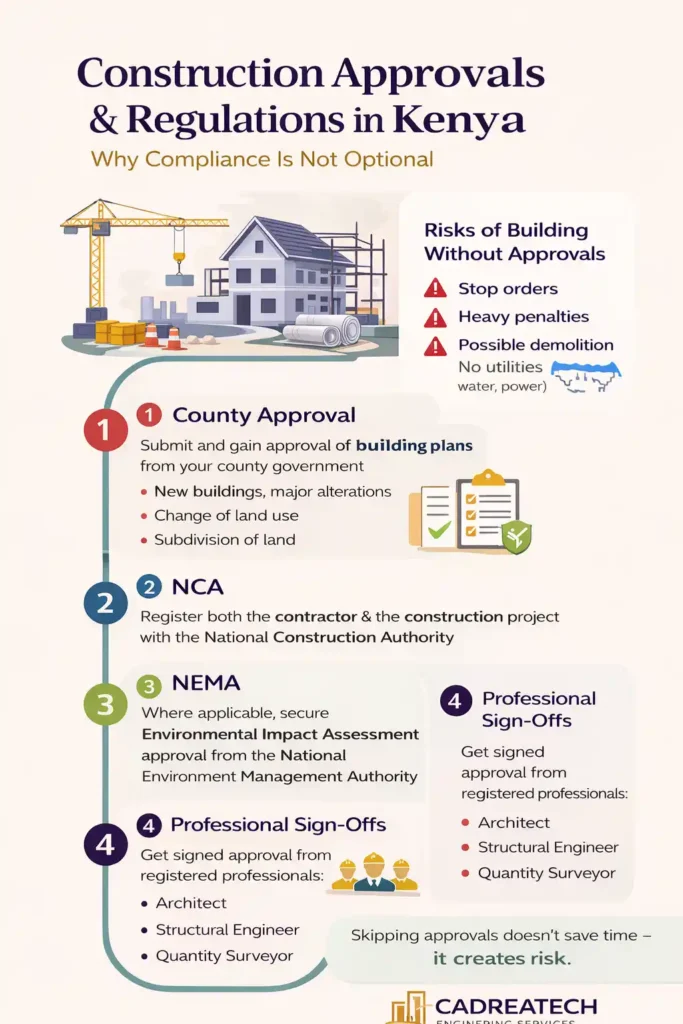
County Government Development Permission
The first and most important approval is development permission from the County Government.
This approval allows construction to legally begin.
Development permission is required for:
- new buildings
- major alterations
- extensions
- change of user (e.g., residential to commercial)
- subdivision or amalgamation of land
Without this approval, construction is considered illegal development.
Documents Required for County Approval
To obtain county development permission, several documents must be submitted.
These include:
- architectural drawings prepared by a registered architect
- structural drawings prepared by a registered engineer
- proof of land ownership (title deed or lease)
- land rates clearance certificate
- survey plans
- submission through the county planning portal
- payment of statutory approval fees
Once submitted, the county planning department reviews the project to ensure compliance with regulations.
For more details on professional architectural design preparation, see
https://cadreatech.com/architectural-services/
Planning Compliance Requirements
County planners review several technical aspects before granting approval.
These include:
Zoning Compliance
Land use zoning determines what type of development is allowed on a property.
Examples include:
- residential zones
- commercial zones
- industrial zones
- mixed-use zones
Building a commercial structure in a residential zone without approval may lead to enforcement action.
Plot Coverage Rules
Planning regulations limit how much of the land can be covered by buildings.
This ensures that properties maintain open space for:
- ventilation
- drainage
- landscaping
Setback Requirements
Setbacks define how far buildings must be from property boundaries.
They help maintain:
- privacy
- safety
- infrastructure access
Building Height Limits
Some areas restrict building height to control density and protect urban planning goals.
If a design violates these limits, the project must be revised before approval.
Typically, county approval timelines range from 30 to 90 days, depending on the completeness of the submission.
National Construction Authority (NCA)
Another important regulator is the National Construction Authority (NCA).
The NCA oversees construction standards across Kenya.
Its main goal is to ensure that construction projects are executed by qualified professionals.
Contractor Registration
Before starting work, the contractor must be registered with the NCA.
Registration confirms that the contractor has the capacity and expertise to undertake construction work.
Contractors are classified according to the size and complexity of projects they can handle.
Project Registration
In addition to contractor registration, the construction project itself must be registered with the NCA.
Project registration allows the authority to:
- monitor construction activities
- enforce safety standards
- ensure compliance with industry regulations
More information can be found on the official NCA website:
Environmental Approval (NEMA)
Some projects also require environmental approval from the National Environment Management Authority (NEMA).
NEMA ensures that developments do not harm ecosystems or communities.
Projects that may require environmental approval include:
- large residential estates
- commercial developments
- industrial projects
- developments near rivers or wetlands
In these cases, an Environmental Impact Assessment (EIA) may be required.
The EIA evaluates how a project may affect:
- ecosystems
- water resources
- nearby communities
- waste management systems
For more information, visit: https://nema.go.ke/
Professional Sign-Offs and Accountability
Construction approvals also require professional responsibility.
Several registered professionals must review the project before submission.
These may include:
- architects
- structural engineers
- quantity surveyors
Each professional plays a specific role.
Architects ensure planning compliance.
Structural engineers ensure structural safety.
Quantity surveyors manage project cost planning.
“Buildings fail when no one is accountable.”
Professional oversight ensures that buildings are safe, functional, and financially realistic.
Why Approvals Sometimes Take Time
Many clients become frustrated with approval timelines.
However, approvals require technical review to ensure compliance with regulations.
Several factors influence approval timelines.
Common Causes of Approval Delays
Approvals may take longer when:
- drawings are incomplete
- zoning conflicts exist
- structural calculations require review
- documentation is missing
- planners request revisions
- application volumes are high
Approvals often feel slow when submissions are incomplete or poorly prepared.
When professionals prepare compliant documentation from the start, the process becomes much smoother.
“Approvals delay projects not because officers hate you — but because drawings must meet the law.”
The Risks of Building Without Approvals
Some developers attempt to bypass approvals in order to start construction quickly.
However, this approach carries serious risks.
Stop Orders
A stop order halts construction immediately.
During this period:
- workers may remain idle
- contractors demand standby payments
- materials deteriorate on site
- project timelines collapse
“A stop order doesn’t just stop work — it stops your cashflow.”
Financial Penalties
Authorities may impose fines for illegal construction.
These penalties can significantly increase project costs.
In many cases, the cost of correcting compliance issues becomes higher than the cost of obtaining approvals initially.
Demolition Risk
In extreme cases, illegal structures may be demolished.
This usually occurs when buildings violate:
- zoning regulations
- road reserve requirements
- safety standards
“Demolitions erase years of savings in one day.”
Utility Connection Challenges
Buildings without approvals often struggle to obtain:
- electricity connections
- water supply connections
- sewer services
Utility providers frequently require approved building plans before providing services.
Property Transaction Problems
Non-compliant buildings may also create problems later.
These include:
- difficulty selling the property
- challenges transferring ownership
- bank financing issues
- insurance complications
Ultimately, a non-compliant building becomes a legally risky asset.
Compliance Is Cheaper Than Correction
Many people assume approvals are expensive.
However, the real cost often comes from fixing problems later.
“Compliance is cheaper than correction.”
Obtaining approvals early avoids:
- legal complications
- construction delays
- unexpected penalties
It also ensures the project remains financially predictable.
How Early Planning Makes Compliance Easier
The approval process becomes significantly easier when planning begins early.
Several practical steps can speed up the process.
Engage Professionals Early
Experienced consultants understand regulatory requirements and prepare compliant documentation.
This reduces revisions and approval delays.
Design With Regulations in Mind
Architects familiar with planning rules can design projects that comply with zoning regulations from the beginning.
This prevents costly redesigns.
Prepare Documentation Early
Having all required documents ready helps speed up submissions.
Important documents include:
- title deeds
- land rate clearance certificates
- survey plans
- professional drawings
Budget for Approval Costs
Approval fees are part of construction.
These costs should be included in the overall project budget.
Plan for Approval Timelines
Approval timelines should be incorporated into project schedules.
Starting construction without approvals creates unnecessary risk.
Cadreatech’s Role in the Approval Process
Navigating approvals can feel overwhelming for many clients.
At Cadreatech, we guide clients through this process.
Our role includes:
- ensuring documentation is complete
- coordinating professional sign-offs
- reviewing drawings for regulatory compliance
- tracking approval progress
- aligning project schedules with regulatory timelines
This helps clients avoid costly mistakes and ensures projects move forward legally.
Final Takeaway
Construction approvals may seem slow.
However, they exist to protect safety, legality, and long-term investment.
Skipping approvals rarely saves time.
Instead, it creates risk, delays, and financial pressure.
“Skipping approvals doesn’t save time — it creates risk.”
The safest approach is simple.
Build legally.
Build safely.
Build with peace of mind.
Because in construction, compliance is not optional.
It is the foundation of a successful project.
Frequently Asked Questions About Construction Approvals in Kenya
What approvals are required before building in Kenya?
Before construction begins in Kenya, you typically need county development permission, approved architectural and structural drawings, NCA project registration, and in some cases NEMA environmental approval.
What happens if you build without approvals in Kenya?
Building without approvals in Kenya can lead to stop orders, fines, denial of utilities, and in extreme cases demolition of the structure by county authorities.
How long do construction approvals take in Kenya?
County building approvals in Kenya typically take between 30 and 90 days depending on the completeness of the submission and the complexity of the project.
What is NCA registration in construction?
NCA registration is a requirement by the National Construction Authority in Kenya to ensure that contractors and projects meet industry standards and safety regulations.
Does every project require NEMA approval?
Not every project requires NEMA approval. Environmental Impact Assessments are usually required for large developments, commercial projects, or buildings located near sensitive environmental areas.
