
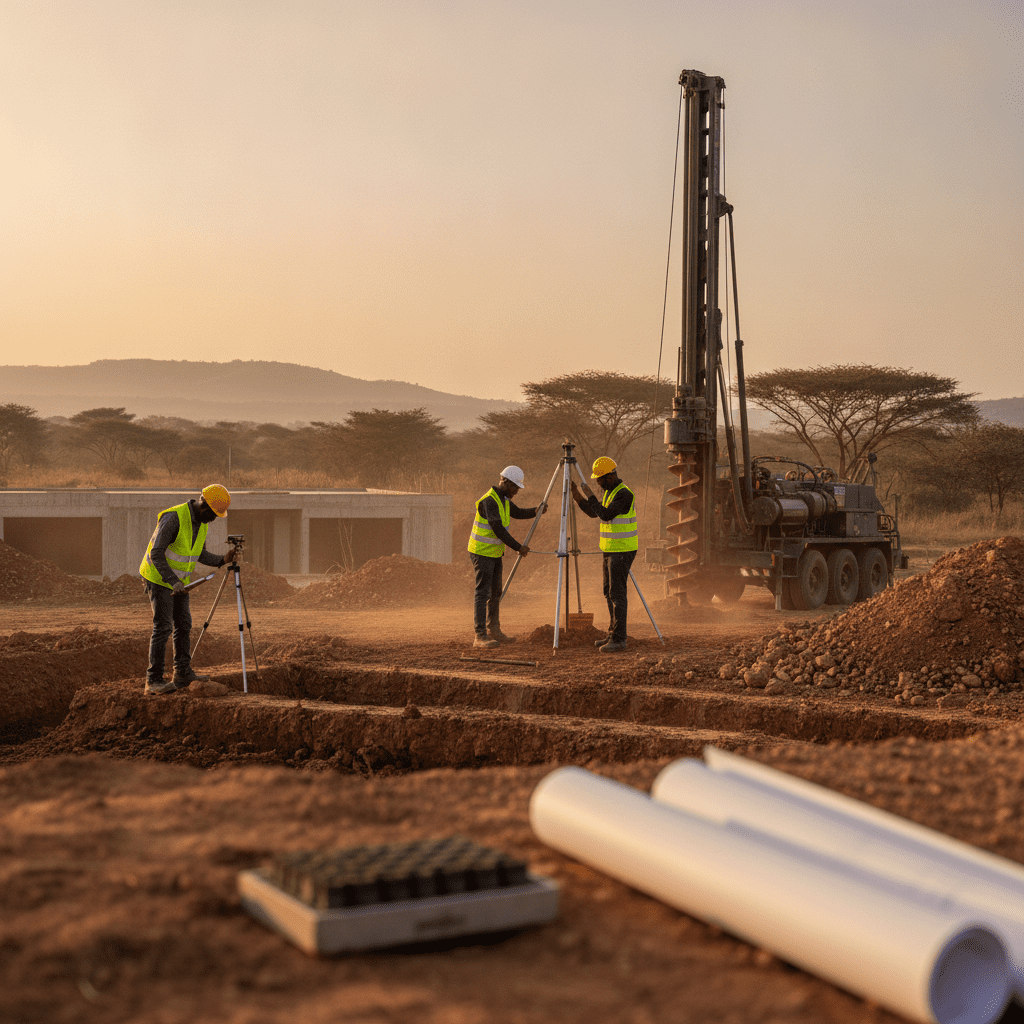
Deep Excavation Design: Shoring, Groundwater, and Stability in Kenya
The rapid urbanisation and densification of Kenya’s major cities, particularly Nairobi, Mombasa, and Kisumu, are driving a growing demand for basements and multi-level underground structures. While offering valuable space, deep excavations inherently present complex engineering challenges, from managing unpredictable soil conditions and high groundwater tables to ensuring the stability of adjacent structures and compliance with local regulations. Navigating these complexities requires a robust understanding of geotechnical engineering principles, advanced shoring techniques, and meticulous project execution to prevent costly delays, structural failures, and safety hazards.
Basements, pools, and retaining walls need hydrostatic and soil pressure considered together. See structural engineering, geotechnical investigation, and structural calculators.
Excavation dewatering differs from permanent abstraction — both need engineering evidence. See hydrogeological survey, geotechnical investigation, and WRA screening for abstraction.
Understanding the Kenyan Subsurface for Deep Excavations
Effective basement and deep excavation design in Kenya begins with a comprehensive understanding of the site’s unique subsurface conditions. Kenya’s geology is remarkably diverse, ranging from the expansive black cotton soils prevalent in areas like Ruiru and Ongata Rongai, to the weathered volcanic rocks and murram common in much of Nairobi, and the marine sands and coral formations along the coast in Mombasa. Each soil type presents distinct challenges: black cotton soils are highly susceptible to volumetric changes with moisture content, leading to significant heave and settlement; murram and weathered rock may offer better bearing capacity but can be highly variable and require specialised excavation techniques; while coastal sands and silts often have low cohesion and high groundwater tables, demanding advanced dewatering and retention strategies.
A thorough geotechnical investigation is not merely a formality but a critical first step. This typically involves a series of boreholes, often extending to depths well below the proposed excavation base and influence zone, to collect representative soil and rock samples. Standard Penetration Tests (SPT) and Cone Penetration Tests (CPT) are routinely conducted to assess soil density, strength parameters, and stratigraphy. For highly sensitive projects or problematic ground conditions, in-situ tests like pressuremeter tests or permeability tests are essential. Laboratory analyses then determine key engineering properties such as shear strength, compressibility, permeability, and consolidation characteristics. Without this detailed data, designs are based on assumptions, significantly increasing the risk of unforeseen ground conditions, inadequate shoring, and potential instability during excavation. For instance, mischaracterising a high-plasticity clay as a stable, granular material could lead to catastrophic slope failures or excessive lateral deflections in shoring systems. Cadreatech emphasises early and comprehensive geotechnical studies, integrating findings directly into the design process to mitigate risks and optimise solutions tailored to Kenya’s specific geological landscape. This proactive approach not only safeguards project integrity but also helps avoid costly redesigns and delays. Engineers considering the long-term performance of these structures often integrate principles of Green Building Design in Kenya, ensuring that the ground engineering solutions are not only stable but also environmentally responsible, particularly concerning groundwater management and material selection.
| Aspect | Impact on Deep Excavation Project |
|---|---|
| Groundwater Level | Significantly affects dewatering system complexity, shoring design, and cost. |
| Adjacent Structures | Dictates stricter deflection limits, requiring more robust shoring and monitoring. |
| Soil Type (e.g., Black Cotton) | Requires specific design for expansive pressures or ground improvement techniques. |
| Excavation Depth | Increases lateral pressures, requiring heavier shoring sections and deeper anchors. |
| Site Access & Logistics | Influences choice of shoring method and equipment, impacting construction speed. |
| Regulatory Approvals | Can introduce significant delays if documentation is incomplete or non-compliant. |
Principles of Shoring and Earth Retention Systems in Kenya
Once the subsurface conditions are thoroughly understood, selecting and designing an appropriate shoring and earth retention system becomes paramount for any deep excavation in Kenya. The choice of system is influenced by several critical factors: the depth and geometry of the excavation, the prevailing soil and groundwater conditions, the presence and sensitivity of adjacent structures (e.g., existing buildings, roads, utilities), available working space on site, and the project’s overall timeline and budget. Common shoring methods employed in Kenya include sheet pile walls, soldier pile and lagging systems, secant or tangent pile walls, diaphragm walls, and in some cases, temporary sloping or soil nailing for less constrained sites.
Sheet pile walls, often constructed from steel, are driven or vibrated into the ground to form a continuous barrier. They are particularly effective in soft to medium cohesive soils and granular soils, especially where groundwater control is a major concern, such as in coastal areas of Mombasa or along riverine zones in Kisumu. Their interlocking nature provides good water tightness, which is crucial for managing ingress. Soldier pile and lagging systems involve installing vertical steel H-piles or concrete piles at regular intervals, with timber, precast concrete, or shotcrete lagging placed between the piles as excavation proceeds. This method is versatile and suitable for a wide range of soil conditions, particularly in urban settings like Nairobi where space might be tight and adjacent structures need careful protection. For very deep excavations or in challenging ground conditions such as highly variable soils or high water tables, secant or tangent pile walls offer a robust solution. Secant piles are interlocked reinforced concrete piles, providing excellent stiffness and water control, while tangent piles are constructed adjacent to each other without interlock, offering a stiff wall but less water tightness. Diaphragm walls, constructed using specialised trenching equipment and bentonite slurry, offer the highest level of stiffness and water retention, suitable for the deepest basements and tunnels, though they are more complex and costly to implement.
The design of these systems must account for various loads, including lateral earth pressure, surcharge from adjacent buildings or traffic, hydrostatic pressure from groundwater, and potential seismic loads, given Kenya’s moderate seismic activity. Stability analysis considers both global stability (preventing overall collapse of the retained soil mass) and local stability (preventing failure of individual components like lagging or anchors). Groundwater management is often a critical aspect, especially in permeable soils or near water bodies. Dewatering systems, such as wellpoints or deep wells, are frequently integrated into the shoring design to lower the water table and reduce hydrostatic pressures on the retention system and the excavation base, preventing uplift or boiling conditions. For projects requiring significant structural support, like multi-storey basements or large-span underground spaces, the interface with the permanent foundation and structural elements, including potential connections to Steel Structure Design (Warehouses, Frames and Towers), needs meticulous planning to ensure seamless load transfer and long-term performance. Cadreatech’s engineers meticulously analyse these factors, employing advanced geotechnical software and design methodologies to develop safe, efficient, and constructible shoring solutions that meet the specific demands of each Kenyan project site.
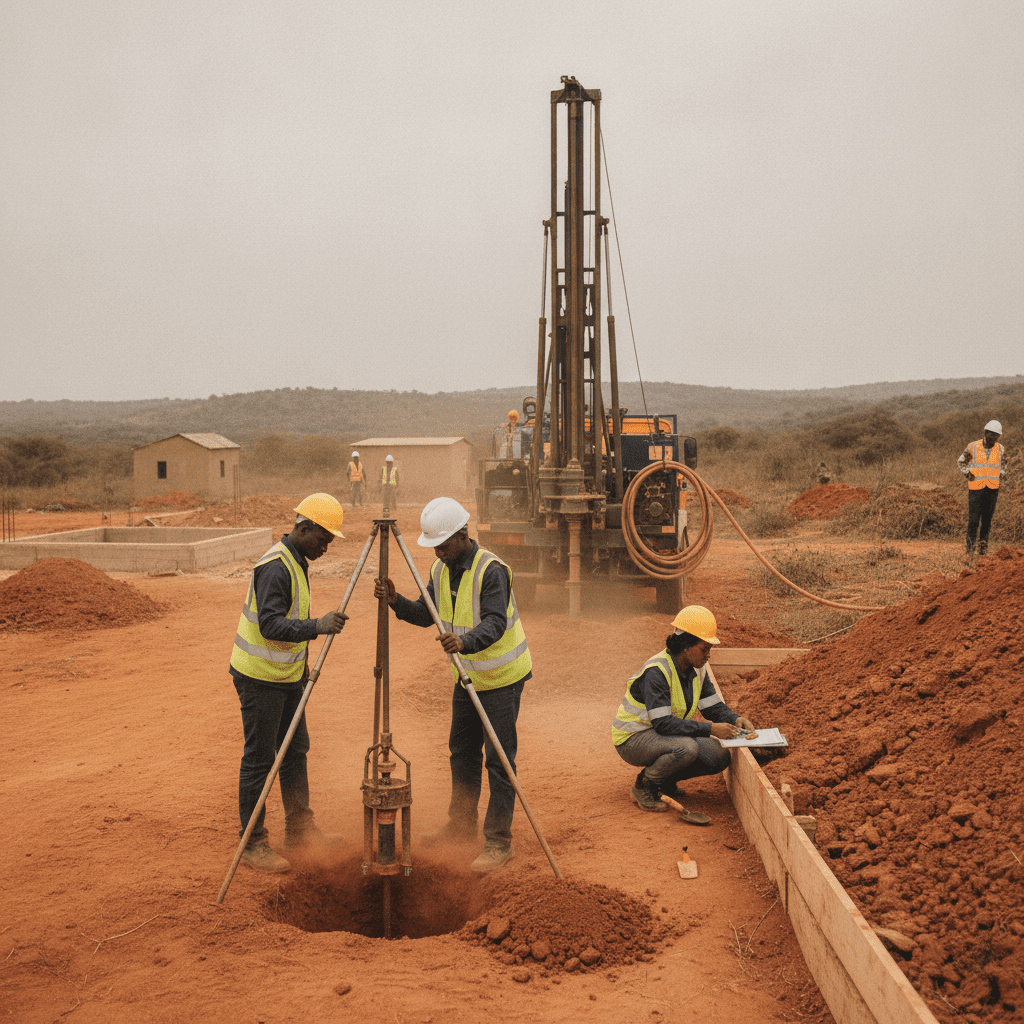
Successful basement and deep excavation projects in Kenya hinge on a meticulous geotechnical investigation and a comprehensive site assessment. This foundational phase is not merely a formality but a critical engineering exercise that dictates the feasibility, design, safety, and ultimately, the cost-effectiveness of the entire undertaking. Without a thorough understanding of the subsurface conditions, engineers risk encountering unforeseen challenges such as unstable ground, unexpected groundwater inflows, or differential settlement, leading to significant delays, budget overruns, and potential structural failures.
Cadreatech approaches geotechnical investigations with a multi-layered strategy, commencing with a detailed desk study. This initial phase involves reviewing existing geological maps, historical land use records, previous boreholes or foundation reports for adjacent properties (if available), and topographical surveys. For projects in Nairobi, for instance, understanding the underlying volcanic rocks and residual soils is crucial, while in Kajiado, the prevalence of expansive black cotton soils demands specific attention to potential swell-shrink behaviour. Coastal regions like Mombasa necessitate an assessment of highly corrosive environments and often high water tables in sandy strata.
Following the desk study, a site reconnaissance is conducted to observe surface features, drainage patterns, evidence of existing instability, and the proximity of adjacent structures. This visual inspection provides qualitative data that guides the planning of intrusive investigations. The intrusive phase typically involves drilling boreholes to specific depths, often ranging from 15 to 30 meters or more for deep basements, to retrieve soil and rock samples and conduct in-situ tests. The choice of drilling method depends on the expected ground conditions, with rotary wash boring common for softer soils and diamond core drilling for rock formations.
Standard Penetration Tests (SPT) are routinely performed within boreholes at regular intervals (typically 1.0 to 1.5 meters) to assess the relative density of granular soils and the consistency of cohesive soils. The ‘N’ values obtained from SPTs are crucial for estimating soil strength parameters and bearing capacities. For projects requiring more continuous data, Cone Penetration Tests (CPT) can be deployed, providing a rapid and detailed profile of soil stratigraphy, shear strength, and pore water pressure. In areas with highly variable ground, such as residual soils from weathered granites, both SPT and CPT provide complementary data for robust design.
Engineer Note: The Black Cotton Soil Challenge
In regions like Ruiru, Kitengela, or parts of Kisumu, black cotton soils pose a significant challenge for deep excavations. These highly expansive clays exhibit substantial volume changes with variations in moisture content, leading to considerable uplift pressures on basement slabs and lateral pressures on retaining walls. Cadreatech’s investigations specifically target the identification of these soils, their activity index, and swelling potential through advanced laboratory testing, ensuring appropriate design measures such as deep foundations, ground improvement, or specific drainage strategies are incorporated to mitigate risks.
Retrieved soil and rock samples are subjected to a battery of laboratory tests. These include soil classification (Atterberg limits, particle size distribution), moisture content, density, and critical strength tests such as unconfined compressive strength (UCS) for cohesive soils and rocks, and direct shear or triaxial compression tests to determine cohesion and angle of internal friction. For groundwater-intensive sites, permeability tests are vital to inform dewatering design. The comprehensive data from these tests forms the basis for developing a detailed ground model, which is essential for accurate shoring design and stability analysis.
Inadequate geotechnical investigation can lead to catastrophic consequences. Underestimating groundwater levels can result in uncontrollable water ingress, undermining the stability of the excavation and adjacent structures. Mischaracterizing soil strength can lead to under-designed shoring systems that fail under lateral earth pressures, causing collapses and significant safety hazards. Cadreatech emphasizes the importance of this phase, recognising it as the bedrock of a safe and successful deep excavation project, aligning with principles of Green Building Design in Kenya by ensuring resource efficiency and long-term structural integrity from the outset.
Cadreatech follows a structured, multi-step process to ensure all critical subsurface parameters are accurately assessed for deep excavation projects:
- Project Initiation & Desk Study: Review site plans, proposed excavation depths, adjacent structures, and available geological data, including satellite imagery and historical land use.
- Site Reconnaissance & Preliminary Assessment: Visual inspection of the site and surrounding area to identify potential hazards, existing infrastructure, and access limitations.
- Detailed Investigation Planning: Develop a precise borehole layout, depths, and testing schedule based on the desk study and preliminary assessment, considering proposed basement footprints and structural loads.
- Field Investigations: Execute drilling of boreholes, trial pits, and conduct in-situ tests (SPT, CPT, permeability tests) under strict supervision, ensuring accurate data collection and sample retrieval.
- Laboratory Testing: Transport samples to accredited laboratories for a full suite of tests including classification, strength parameters, consolidation, and chemical analysis (especially for coastal or industrial sites).
- Data Analysis & Ground Modelling: Interpret field and laboratory data to develop a comprehensive subsurface profile, including soil stratigraphy, groundwater levels, and engineering parameters.
- Geotechnical Investigation Report (GIR) Generation: Compile all findings, analyses, and engineering recommendations into a detailed GIR, providing design parameters for foundations, shoring, and dewatering.
The output of this rigorous process is a Geotechnical Investigation Report (GIR) that serves as the cornerstone for all subsequent design phases. It details the subsurface conditions, provides recommended design parameters, and identifies potential geotechnical hazards, allowing our structural engineers to develop robust and compliant designs for shoring, foundations, and groundwater control. Cadreatech ensures that this report is not just a document, but a practical guide for the entire project team, mitigating risks from the ground up.
Once the geotechnical investigation provides a clear picture of the subsurface, the focus shifts to the intricate engineering of shoring systems and groundwater management strategies. For deep excavations, especially in urban centres like Nairobi with dense adjacent buildings or in coastal regions like Mombasa with high water tables, the design of temporary and permanent retaining structures is paramount for both safety and project success. Cadreatech’s approach integrates advanced analytical methods with practical construction considerations, adhering strictly to relevant Kenyan building codes and international standards such as Eurocode 7 (Geotechnical design).
Shoring systems are designed to resist lateral earth pressures, surcharge loads from adjacent structures, and hydrostatic pressures from groundwater. The selection of the most appropriate shoring method is a complex decision influenced by excavation depth, soil type, groundwater conditions, proximity to existing structures, site access, construction duration, and desired deflection limits. Common systems employed in Kenya include:
- Sheet Pile Walls: Often used in soft to medium soils and high water table conditions (e.g., Kisumu lakefront projects), providing both earth retention and groundwater cut-off. Steel sheet piles are driven or vibrated into the ground.
- Soldier Pile and Lagging Walls: Consisting of vertical steel H-piles or bored concrete piles (soldier piles) installed at intervals, with horizontal timber or precast concrete lagging panels placed between them as excavation proceeds. Effective in various soil types, particularly where groundwater can be managed.
- Contiguous Bored Pile Walls: A series of closely spaced bored concrete piles, forming a continuous wall. Provides high stiffness and can be designed as a permanent retaining structure.
- Secant Pile Walls: Interlocking bored concrete piles, where secondary piles cut into primary piles, creating a more watertight and rigid wall, ideal for challenging ground and high groundwater conditions.
- Diaphragm Walls: Constructed by excavating a trench under bentonite slurry and then filling it with concrete, forming a continuous, rigid, and often permanent wall. Suitable for very deep excavations and complex urban sites.
Each system requires detailed structural analysis, considering bending moments, shear forces, and axial loads, as well as the interaction between the soil and the structure. Anchors (tie-backs) or internal bracing (struts) are frequently incorporated to provide additional lateral support, especially for deeper excavations, to control wall deflections and ensure the stability of the system and surrounding ground. For projects near sensitive structures, such as in Nairobi’s CBD, precise deflection monitoring and instrumentation are crucial during excavation.
Checklist: Key Aspects of Shoring Design Review
- Lateral earth pressure calculations (active, at-rest, passive states)
- Surcharge loads from adjacent structures and construction equipment
- Hydrostatic pressure considerations and dewatering requirements
- Global stability analysis (slip circle, wedge failure)
- Base heave analysis for cohesive soils
- Wall deflection limits and monitoring plan
- Design of temporary bracing or tie-back anchors
- Consideration of seismic loads (where applicable)
- Durability and corrosion protection for permanent elements (e.g., coastal Mombasa)
Groundwater management is often as critical as the shoring itself. High water tables, common in areas like Kisumu or the coastal belt, can lead to instability of excavation slopes, base heave, and significant construction challenges. Cadreatech designs bespoke dewatering systems, which may include wellpoint systems, deep wells, sumps with pumps, or even cutoff walls (e.g., sheet piles, grout curtains) to lower the groundwater table within and around the excavation. The design considers soil permeability, required drawdown depth, and potential impacts on adjacent structures due to ground settlement caused by dewatering. Environmental regulations regarding water discharge are also meticulously followed.
Base heave stability is a critical consideration for deep excavations in soft, cohesive soils. The upward pressure from the underlying soil can cause the base of the excavation to lift, leading to instability. Cadreatech performs detailed finite element analysis to assess base heave potential and designs remedial measures such as soil improvement, temporary berms, or ensuring sufficient embedment of shoring systems. Similarly, global stability analysis ensures that the entire soil mass surrounding the excavation remains stable, preventing large-scale slope failures.
Cadreatech provides a comprehensive suite of deliverables to ensure clarity, compliance, and constructability for every project:
- Geotechnical Investigation Report (GIR): A detailed document outlining subsurface conditions, engineering parameters, and recommendations for foundation and excavation design.
- Shoring Design Report: This report details the selected shoring system, design calculations, stability analyses (lateral earth pressure, global stability, base heave), and deflection predictions.
- Structural Drawings for Shoring and Temporary Works: Fully detailed engineering drawings, including plans, sections, elevations, connection details, and material specifications for the shoring system, bracing, and anchors. These drawings are suitable for contractor tendering and construction. Our expertise in Steel Structure Design is particularly relevant for steel sheet piles and soldier pile systems.
- Groundwater Management Plan: Drawings and specifications for the dewatering system, including well locations, pump capacities, discharge routes, and monitoring requirements.
- Instrumentation and Monitoring Plan: For complex projects or those adjacent to sensitive structures, this plan specifies the type, location, and frequency of monitoring instruments (e.g., inclinometers, extensometers, piezometers, settlement markers) to track ground movement and pore water pressures during construction.
- Construction Specifications: Detailed written instructions for the installation, inspection, and maintenance of the shoring and dewatering systems, ensuring adherence to design intent and safety standards.
- Risk Assessment & Mitigation Strategy: Identification of potential construction risks related to excavation and proposed mitigation measures.
Warning: Consequences of Neglecting Professional Deep Excavation Design
Skipping expert geotechnical and structural design for deep excavations carries severe risks. These include catastrophic wall collapses, leading to fatalities and injuries on site. Adjacent properties can experience significant settlement, cracking, or even structural failure, resulting in costly litigation and repair. Project timelines can be extended indefinitely due to unforeseen ground conditions or remedial works. Furthermore, non-compliance with NEMA regulations for dewatering discharge or local county building codes can lead to hefty fines and project stoppages. Engaging Cadreatech ensures these critical risks are professionally managed.
The timeline for basement and deep excavation projects varies significantly based on complexity, depth, ground conditions, and local authority approval processes. A typical project might follow these phases:
- Geotechnical Investigation: 2-4 weeks (depending on scope, drilling depths, and lab testing turnaround).
- Shoring & Dewatering Design: 3-6 weeks (for detailed engineering, analysis, and drawing production).
- County Approvals (Nairobi, Mombasa, Kisumu): 4-12 weeks (can be highly variable, influenced by completeness of submissions and county workload).
- Procurement & Mobilisation: 2-4 weeks (for specialist shoring contractors, material ordering).
- Shoring & Excavation Works: Highly variable, from 8 weeks to 6 months or more, depending on depth, soil type, and dewatering requirements.
Factors that can extend these timelines include unexpected ground conditions encountered during excavation, delays in permit approvals, changes in design scope, adverse weather conditions, and challenges with groundwater management. Cadreatech works closely with clients and contractors to anticipate and mitigate these delays, providing expert consultation throughout the project lifecycle.
| Shoring System | Key Considerations for Kenyan Projects |
|---|---|
| Sheet Pile Walls | Ideal for soft, granular soils and high groundwater, common in coastal Mombasa or riverine Kisumu. |
| Soldier Pile & Lagging | Versatile for varied soil types, often used in tight Nairobi urban sites with adjacent structures. |
| Secant/Tangent Pile Walls | Provides high stiffness and water control for deep excavations and challenging ground conditions. |
| Diaphragm Walls | Offers maximum stiffness and water retention for the deepest basements, requires specialised equipment. |
| Soil Nailing/Temporary Slopes | Suitable for less constrained sites with stable soil, often combined with shotcrete facing. |
Geotechnical Investigation and Site Assessment for Deep Excavations
Process: Conducting a Comprehensive Geotechnical Investigation
| Geotechnical Test | Primary Application in Deep Excavations |
|---|---|
| Standard Penetration Test (SPT) | Estimating relative density of granular soils and consistency of cohesive soils. |
| Cone Penetration Test (CPT) | Continuous profiling of soil stratigraphy, strength, and pore water pressure. |
| Undrained Triaxial Compression Test | Determining shear strength parameters (cohesion, angle of friction) for cohesive soils. |
| Permeability Test (Falling Head/Constant Head) | Assessing hydraulic conductivity to inform dewatering system design. |
| Atterberg Limits Test | Classifying fine-grained soils and assessing their plasticity and expansive potential. |
| Unconfined Compressive Strength (UCS) | Measuring the compressive strength of cohesive soils and weak rock samples. |
Shoring Design, Groundwater Management, and Project Deliverables
Typical Deliverables for Basement and Deep Excavation Design
Project Timelines and Influencing Factors
What Has Happened vs. What Should Happen: Deep Excavation Planning
What Has Happened (Common Pitfalls)
Inadequate Geotechnical Scope: Relying on limited boreholes or outdated reports, leading to surprises like unexpected rock layers, high water tables, or expansive clays.
Generic Shoring Design: Applying a standard shoring solution without detailed analysis of specific site conditions, resulting in over-design or, critically, under-design.
Ignoring Groundwater: Assuming simple sump pumping will suffice, leading to uncontrolled water ingress, base instability, and damage to adjacent properties.
Skipping Monitoring: Failing to install inclinometers or settlement markers, meaning ground movements go undetected until significant damage occurs.
Delayed Approvals: Submitting incomplete or non-compliant design documents to county authorities, causing lengthy review processes and project halts.
What Should Happen (Cadreatech’s Approach)
Comprehensive Geotechnical Investigation: Multi-stage investigation including desk study, targeted boreholes, in-situ tests, and advanced lab testing to create a robust ground model.
Tailored Shoring Solution: Engineering a bespoke shoring system (sheet piles, soldier piles, contiguous piles) precisely matched to soil conditions, excavation depth, and adjacent structure sensitivity.
Proactive Groundwater Management: Designing an effective dewatering system (wellpoints, deep wells, cutoff walls) to maintain a stable and dry excavation, with environmental compliance.
Integrated Instrumentation & Monitoring: Implementing a robust monitoring plan from the start, providing real-time data to ensure safety and control deflections.
Streamlined Approval Process: Providing meticulously prepared, fully compliant engineering designs and reports to facilitate smooth and efficient county approvals.
Cadreatech’s expertise ensures that deep excavation projects are executed with the highest standards of safety, efficiency, and compliance. By proactively addressing geotechnical challenges and meticulously designing shoring and dewatering systems, we safeguard investments and deliver successful project outcomes across Kenya.
Partner with Cadreatech for Expert Engineering Solutions
Navigating the complexities of basement and deep excavation design requires specialized expertise and a deep understanding of local conditions. Cadreatech offers comprehensive engineering consultancy services, from initial geotechnical investigations to detailed shoring and dewatering designs, ensuring your project’s success and safety.
Contact us today to discuss your project requirements and receive a tailored quotation.
Phone: +254 719 532 233
Email: info@Cadreatech.com
Website: Cadreatech.com
