

Bridge and Culvert Assessment: Safeguarding Kenya’s Lifelines
Kenya’s extensive road network relies heavily on its bridges and culverts, critical structures that ensure connectivity across diverse terrains and waterways. However, these vital components of infrastructure are constantly exposed to environmental stressors, increasing traffic loads, and the natural process of aging. The integrity of these structures is paramount for public safety and sustained economic activity. Without systematic and expert structural assessments, minor defects can escalate into significant failures, leading to service disruptions, costly emergency repairs, and, in worst-case scenarios, catastrophic collapse. Understanding the mechanisms of deterioration and implementing robust assessment protocols is essential for the long-term resilience of Kenya’s transport infrastructure.
Cracks, additions, and change-of-use need engineering evidence — not guesswork. See building cracks assessment, retrofitting & strengthening, and pre-purchase inspection.
Why Regular Structural Assessment is Indispensable for Infrastructure
The structural health of bridges and culverts directly impacts the safety and efficiency of Kenya’s transportation system. These structures, whether crossing rivers in Kisumu, traversing the challenging terrain of the Rift Valley, or managing storm runoff in urban centres like Nairobi, are subjected to a complex interplay of forces. Dynamic loads from vehicles, ranging from light passenger cars to heavy commercial trucks, induce fatigue and stress on structural elements. Environmental factors such as extreme temperatures, heavy rainfall, and seismic activity contribute to material degradation. In coastal regions like Mombasa, the corrosive effects of saline air and water accelerate the deterioration of concrete and steel components, demanding specialized inspection considerations.
Neglecting regular structural assessments can lead to a cascade of problems. Initially, minor cracks, spalling concrete, or corrosion might appear insignificant, but these are often indicators of deeper underlying issues. Over time, these defects compromise the load-carrying capacity of the structure, increasing the risk of sudden failure. The consequences extend beyond immediate structural damage; they include severe safety hazards for users, prolonged traffic diversions causing economic losses, and significant costs associated with emergency repairs or complete reconstruction. Furthermore, non-compliance with engineering standards and regulatory requirements can lead to legal liabilities and reputational damage for responsible authorities.
A comprehensive assessment identifies critical areas of distress, quantifies the extent of damage, and evaluates the remaining service life. This proactive approach allows engineers to recommend timely and appropriate interventions, ranging from routine maintenance to major rehabilitation. For instance, early detection of scour around culvert foundations, common in areas with high seasonal rainfall like parts of Kajiado County, can prevent catastrophic washouts. Similarly, identifying fatigue cracks in steel girders or delamination in bridge decks allows for planned repairs, avoiding the higher costs and greater risks of reactive measures. Such assessments are also crucial when considering changes in traffic patterns or proposed upgrades, ensuring the structure can safely accommodate new demands, much like how a change of use building Kenya — structural assessment before conversion is vital for properties.
Ignoring early signs of structural distress in bridges and culverts can lead to accelerated degradation, sudden failures, and severe safety risks. Deterioration often progresses rapidly once critical elements are compromised, making timely intervention essential to prevent catastrophic outcomes and ensure public safety.
| Common Bridge/Culvert Issue | Assessment Focus and Action |
|---|---|
| Scour and Erosion at Foundations | Hydrographic surveys, visual inspection of riverbeds, sonar imaging, and depth measurements to quantify material loss and potential undermining. Recommendations include scour protection measures. |
| Concrete Spalling and Cracking | Visual mapping of crack patterns, rebound hammer tests, ultrasonic pulse velocity, carbonation depth tests, and chloride content analysis. Action involves concrete repair, crack injection, or patch repair. |
| Corrosion of Steel Reinforcement | Half-cell potential mapping, covermeter surveys to determine rebar depth, and core sampling for direct examination. Remedial action includes cathodic protection or concrete replacement. |
| Bearing Pad Degradation | Visual inspection for cracking, displacement, or loss of material in elastomeric or metallic bearings. Recommendations include replacement or repair to restore proper load transfer. |
| Abutment or Wingwall Settlement | Topographical surveys, inclinometer readings, and visual checks for differential movement. Remedial actions may involve underpinning, soil stabilization, or reconstruction. |
The Phased Approach to Bridge and Culvert Structural Inspection
A systematic and phased approach is critical for effective bridge and culvert structural inspection, ensuring all components are thoroughly examined and potential issues are accurately identified. This process typically involves several key stages, each building upon the findings of the previous one, providing a comprehensive understanding of the structure’s condition.
- Preliminary Document Review and Site Reconnaissance: Before any physical inspection, engineers review available documentation, including original design drawings, construction records, previous inspection reports, and maintenance logs. This provides historical context, identifies critical design features, and highlights areas that may have experienced past issues. A brief site reconnaissance helps in understanding the general site conditions, accessibility, and immediate environmental factors.
- Detailed Visual Inspection: This is the cornerstone of any assessment. Trained engineers meticulously inspect all accessible elements of the bridge or culvert, including the deck, superstructure (beams, girders, trusses), substructure (piers, abutments), foundations, expansion joints, bearings, railings, and drainage systems. They look for specific distress indicators such as:
- Cracking: Classifying cracks by type (flexural, shear, longitudinal, map cracking), width (e.g., hairline < 0.1 mm, minor 0.1-0.5 mm, moderate 0.5-1.0 mm, severe > 1.0 mm), pattern, and location.
- Spalling and Delamination: Concrete breaking away from the surface, often exposing reinforcement.
- Corrosion: Rusting of steel elements, including reinforcement bars (indicated by rust stains on concrete), steel girders, and bearings.
- Scour and Erosion: Loss of soil around foundations, particularly critical for culverts and bridge piers in riverbeds, common in areas with black cotton or murram soils.
- Deflection and Settlement: Visible sagging of decks or uneven settlement of piers/abutments.
- Joint Deterioration: Failure of expansion joints, allowing water ingress or restricting movement.
Measurements are taken, and observations are meticulously recorded, often with photographic documentation.
- Non-Destructive Testing (NDT): Where visual inspection indicates potential hidden defects or further quantification is required, NDT methods are employed. These include:
- Rebound Hammer (Schmidt Hammer): To estimate concrete compressive strength.
- Ultrasonic Pulse Velocity (UPV): To assess concrete quality, detect voids, and estimate dynamic modulus of elasticity.
- Cover Meter: To determine the depth of concrete cover over reinforcement and detect rebar location.
- Ground Penetrating Radar (GPR): For imaging subsurface elements, detecting voids, or assessing deck conditions.
- Infrared Thermography: To detect delamination in bridge decks.
These tests provide quantitative data without damaging the structure, informing further analysis.
- Destructive Testing (DT) and Material Sampling (If Required): In cases where NDT results are inconclusive or a precise understanding of material properties is needed, limited destructive testing may be performed. This involves taking core samples from concrete for laboratory testing (e.g., compressive strength, petrographic analysis) or extracting small samples of steel for metallurgical analysis. These tests provide definitive material properties crucial for accurate structural analysis.
- Data Analysis and Structural Modelling: All collected data from visual inspections, NDT, and DT are meticulously analyzed. Engineers use this information to update or create structural models of the bridge or culvert. Advanced software is often employed to perform load rating calculations, assess the structure’s capacity against current design codes (e.g., Kenya Roads Design Manuals, BS EN standards), and predict its behaviour under various loading conditions. This stage determines if the structure meets serviceability and ultimate limit state requirements.
- Reporting and Recommendations: The final stage involves compiling a comprehensive structural assessment report. This document details the inspection methodology, observations, test results, structural analysis findings, and a clear statement on the current condition and load-carrying capacity. Crucially, it includes actionable recommendations for repair, rehabilitation, strengthening, or replacement, along with proposed timelines and estimated urgency. This report forms the basis for informed decision-making by asset owners and infrastructure managers, much like a pre-purchase structural inspection Kenya informs a buyer about a property’s condition.
A systematic and thorough structural assessment of existing bridges and culverts is critical for ensuring their long-term serviceability and safety, particularly in Kenya’s diverse geographical and climatic regions. This process extends beyond a superficial visual check, delving into the material integrity, load-carrying capacity, and potential failure mechanisms. A qualified structural engineer employs a multi-stage methodology to gather comprehensive data, analyse findings, and provide actionable recommendations.
- Preliminary Data Review and Site Reconnaissance: The initial phase involves collecting all available documentation, including original design drawings, construction records, maintenance logs, and previous inspection reports. This historical data provides crucial insights into the structure’s design intent, materials used, and any past issues or repairs. A preliminary site visit allows engineers to understand the access conditions, environmental context, and identify any immediately apparent distress or hazards, informing the scope of detailed investigations. For instance, a culvert in Kajiado County might show signs of severe scour due due to flash floods, while a bridge near the Mombasa coastline could exhibit significant chloride-induced corrosion.
- Detailed Visual Inspection and Condition Mapping: This is the cornerstone of any assessment. Engineers conduct a meticulous visual survey of all structural components, including the deck, superstructure (beams, girders, trusses), substructure (abutments, piers, foundations), and ancillary elements (bearings, expansion joints, railings). Observations are meticulously documented, identifying and classifying defects such as cracks (flexural, shear, diagonal tension), spalling, delamination, efflorescence, concrete disintegration, steel corrosion, timber decay, and foundation settlement. Crack patterns are mapped, and widths are measured using crack gauges (e.g., to 0.1 mm precision). Detailed photographic records and sketches are indispensable for comprehensive reporting. This phase is analogous to a Pre-Purchase Structural Inspection Kenya, but adapted for infrastructure.
- Non-Destructive Testing (NDT): To ascertain material properties and internal conditions without damaging the structure, various NDT techniques are deployed. Common methods include:
- Rebound Hammer Test (Schmidt Hammer): Provides an indication of the concrete’s surface hardness, which correlates with compressive strength.
- Ultrasonic Pulse Velocity (UPV): Measures the velocity of ultrasonic waves through concrete, indicating concrete quality, homogeneity, and detecting voids or cracks within the element.
- Ground Penetrating Radar (GPR): Used to locate reinforcing steel bars, measure concrete cover, and detect voids or delaminations within the concrete elements or scour beneath foundations.
- Half-Cell Potential Meter: Assesses the likelihood of active corrosion in reinforcing steel by measuring electrochemical potential differences.
- Cover Meter: Precisely determines the depth of concrete cover over reinforcement and the diameter of rebar.
These tests provide quantitative data to supplement visual observations and guide further, more intrusive investigations.
- Destructive Testing (DT) and Material Sampling: When NDT results are inconclusive or a more precise understanding of material properties is required, controlled destructive testing is performed. This includes:
- Core Sampling: Concrete cores are extracted from critical locations for laboratory testing to determine actual compressive strength, density, water absorption, and petrographic analysis.
- Chloride Content Testing: Samples are taken to determine the concentration of chlorides at various depths, critical for assessing the risk and extent of reinforcement corrosion, especially in coastal areas like Mombasa.
- Carbonation Depth Measurement: Phenolphthalein indicator is applied to fresh concrete surfaces to determine the depth of carbonation, which reduces the concrete’s alkalinity and compromises the passive layer around reinforcement.
- Steel Coupon Testing: Small samples of reinforcing steel can be extracted for tensile strength and yield strength determination in a laboratory.
These tests provide definitive material properties essential for accurate structural analysis.
- Structural Analysis and Load Rating: Based on the gathered data from visual inspections, NDT, and DT, engineers develop a structural model of the bridge or culvert. This model is used to perform detailed structural analysis, often employing finite element analysis (FEA) for complex geometries. The primary objective is to determine the current load-carrying capacity (load rating) of the structure and compare it against current design standards and anticipated traffic loads. This identifies any deficiencies in strength or serviceability.
- Reporting and Recommendations: The final stage culminates in a comprehensive structural assessment report. This document details the methodology, findings, material test results, structural analysis, and a clear assessment of the structure’s condition and remaining service life. Crucially, the report provides specific, prioritised recommendations for repair, rehabilitation, strengthening, or replacement, including conceptual repair methodologies and estimated timelines for implementation.
The scope and depth of a bridge or culvert structural assessment are not uniform; they are meticulously tailored to specific site conditions, the type of structure, its age, environmental exposure, and the objectives of the assessment. Understanding these influencing factors is crucial for commissioning an appropriate and effective engineering study.
1. Type and Age of Structure: The design and construction materials of a bridge or culvert significantly dictate the assessment approach. A reinforced concrete slab bridge from the 1970s will have different degradation patterns and analysis requirements than a modern steel truss bridge or an older stone masonry arch culvert. Older structures often demand more extensive material testing due to uncertainties in original construction quality and prolonged exposure to environmental stressors. For instance, bridges constructed before the widespread adoption of modern concrete mix designs may exhibit higher permeability, leading to faster carbonation and rebar corrosion.
2. Environmental Exposure and Location: Kenya’s diverse geography presents unique challenges.
- Coastal Regions (e.g., Mombasa, Kilifi): Structures are exposed to salt-laden air, which accelerates chloride ingress into concrete, leading to rapid reinforcement corrosion. Assessments here often prioritise detailed chloride profiling and half-cell potential mapping.
- Arid and Semi-Arid Zones (e.g., Kajiado, Turkana): Structures face extreme temperature fluctuations, leading to thermal stresses and fatigue. Culverts are particularly vulnerable to severe scour during infrequent but intense flash floods, necessitating detailed hydrological and geotechnical investigations of foundations.
- High-Traffic Urban Areas (e.g., Nairobi, Kisumu): Bridges and culverts endure constant heavy vehicle loading, exhaust fumes, and sometimes chemical spills, contributing to fatigue damage, deck deterioration, and increased maintenance demands. The assessment here often involves detailed fatigue analysis and pavement condition surveys on the deck.
- Regions with Expansive Soils (e.g., Black Cotton Soils in parts of Nairobi, Kajiado): Structures founded on black cotton soils are susceptible to differential settlement, heave, and cracking due to moisture content variations. Foundation investigations become paramount in such areas.
3. Observed Distress and Performance Issues: The presence of visible defects such as excessive cracking, spalling, deflections, settlement, or scour immediately elevates the assessment scope. The nature and severity of these issues guide the selection of specific investigation techniques. For example, significant cracking in a beam would necessitate NDT to check for internal voids or rebar corrosion, potentially followed by core sampling. Where structures are showing signs of distress under current usage, a comprehensive load assessment process becomes critical to determine safe operational limits.
4. Traffic Loading and Future Usage: The current and projected traffic volumes and types significantly influence the load rating and remaining life assessment. A bridge originally designed for lighter traffic may be inadequate for modern heavy goods vehicles. Any proposed change in traffic patterns, an increase in permissible axle loads, or a change in the functional use of the structure (e.g., from pedestrian to light vehicle access) necessitates a re-evaluation of its structural capacity. This factor often drives the need for detailed structural analysis and potentially strengthening recommendations.
5. Regulatory Compliance and Standards: Adherence to local county regulations and national engineering standards (e.g., Kenya Standard KS 2344, relevant Eurocodes or AASHTO standards) is fundamental. The assessment must confirm that the structure meets current safety and performance criteria. Non-compliance can lead to operational restrictions or mandates for costly remedial works.
The deliverables from such an assessment typically include a detailed report with:
- An executive summary outlining key findings and critical recommendations.
- A detailed description of the structure and its history.
- Methodology of inspection and testing.
- Comprehensive photographic evidence of defects.
- Results from NDT and DT, including laboratory reports.
- Structural analysis and load rating calculations.
- Assessment of remaining service life.
- Prioritised recommendations for repair, rehabilitation, strengthening, or replacement, including conceptual designs and maintenance strategies.
Neglecting the structural integrity of bridges and culverts in Kenya poses significant risks, ranging from immediate safety hazards to long-term economic and environmental consequences. The dynamic environmental conditions across Kenya, coupled with evolving traffic demands and material degradation, necessitate regular and thorough structural assessments. Without professional oversight, critical infrastructure can deteriorate unseen, leading to sudden failures that disrupt transport networks, endanger lives, and incur substantial reconstruction costs.
In regions susceptible to heavy rainfall and flash floods, such as parts of Nairobi County along river basins or coastal areas like Mombasa, culverts and small bridges are particularly vulnerable to scour and erosion. The sheer force of floodwaters can undermine foundations, wash away abutments, and compromise the structural support of these vital crossings. Similarly, in areas with expansive soils like black cotton prevalent in Kajiado and parts of Machakos counties, differential settlement can induce significant stresses in bridge and culvert elements, leading to cracking and misalignment if foundations are not adequately designed or regularly monitored. The unique challenges of each geographical zone in Kenya demand a tailored approach to assessment, understanding that a solution for a bridge over the Tana River will differ from one in the arid plains of Turkana.
Warning: Failure to conduct regular structural assessments of bridges and culverts can lead to catastrophic collapses, resulting in loss of life, severe injuries, and prolonged disruption to essential services and economic activities. Such incidents often carry significant legal liabilities for asset owners and managing entities.
Compliance with engineering standards and local regulations is paramount for all infrastructure projects, whether new constructions or existing structures. While Kenya primarily adopts international design codes such as British Standards (BS EN) and American Association of State Highway and Transportation Officials (AASHTO) guidelines, these must be applied with an understanding of local material availability, environmental stressors, and construction practices. An assessment determines if an existing structure still meets these criteria, especially when considering a Change of use building Kenya — structural assessment before conversion or an increase in projected traffic loads on a road network. For instance, increased heavy vehicle traffic through agricultural areas may place stresses on culverts originally designed for lighter loads, accelerating their fatigue and requiring an urgent re-evaluation of their load-bearing capacity.
Furthermore, coastal regions like Kwale and Kilifi face unique challenges from saline environments, which accelerate the corrosion of steel reinforcement within concrete structures. This phenomenon, known as chloride attack, can severely compromise the long-term durability and safety of bridges and culverts if not identified and mitigated early. A comprehensive structural assessment in these areas must include detailed material testing to determine the extent of corrosion and remaining structural capacity. Proactive assessment helps engineers to recommend targeted repairs, such as cathodic protection or specialized coatings, extending the service life of the infrastructure and safeguarding public investment.
Engineer Note: Regular structural assessments are not merely a compliance exercise but a strategic investment in infrastructure longevity. They provide a clear understanding of an asset’s condition, enabling proactive maintenance planning and avoiding the significantly higher costs associated with emergency repairs or full replacement.
The process of structural assessment involves a multi-faceted approach. Initially, a visual inspection identifies obvious signs of distress such as cracks, spalling concrete, exposed reinforcement, settlement, or scour. This is often followed by non-destructive testing (NDT) methods like rebound hammer tests to estimate concrete strength, ultrasonic pulse velocity for detecting internal defects, and ground-penetrating radar (GPR) to map reinforcement. For more critical assessments, destructive testing (DT) may be required, involving core sampling for laboratory analysis of concrete compressive strength, or extraction of steel samples for metallurgical examination. Each stage is crucial for building a comprehensive picture of the structure’s health.
| Common Oversight in Bridge/Culvert Assessment | Recommended Practice for Effective Assessment |
|---|---|
| Focusing solely on visible defects without deeper investigation. | Utilizing a combination of visual inspection, NDT, and selective DT to uncover hidden issues. |
| Inadequate documentation of findings, leading to poor historical records. | Maintaining detailed photographic logs, crack maps, and consistent reporting formats for future reference. |
| Ignoring environmental factors specific to the region (e.g., coastal salinity, heavy rainfall). | Tailoring inspection protocols to address local environmental stressors and their specific impact on materials. |
| Failing to assess scour depth around foundations, especially after flood events. | Regularly monitoring and measuring scour potential at piers and abutments, particularly for structures in waterways. |
| Lack of a systematic approach, leading to inconsistent inspection quality. | Adhering to a phased, systematic inspection methodology executed by qualified structural engineers. |
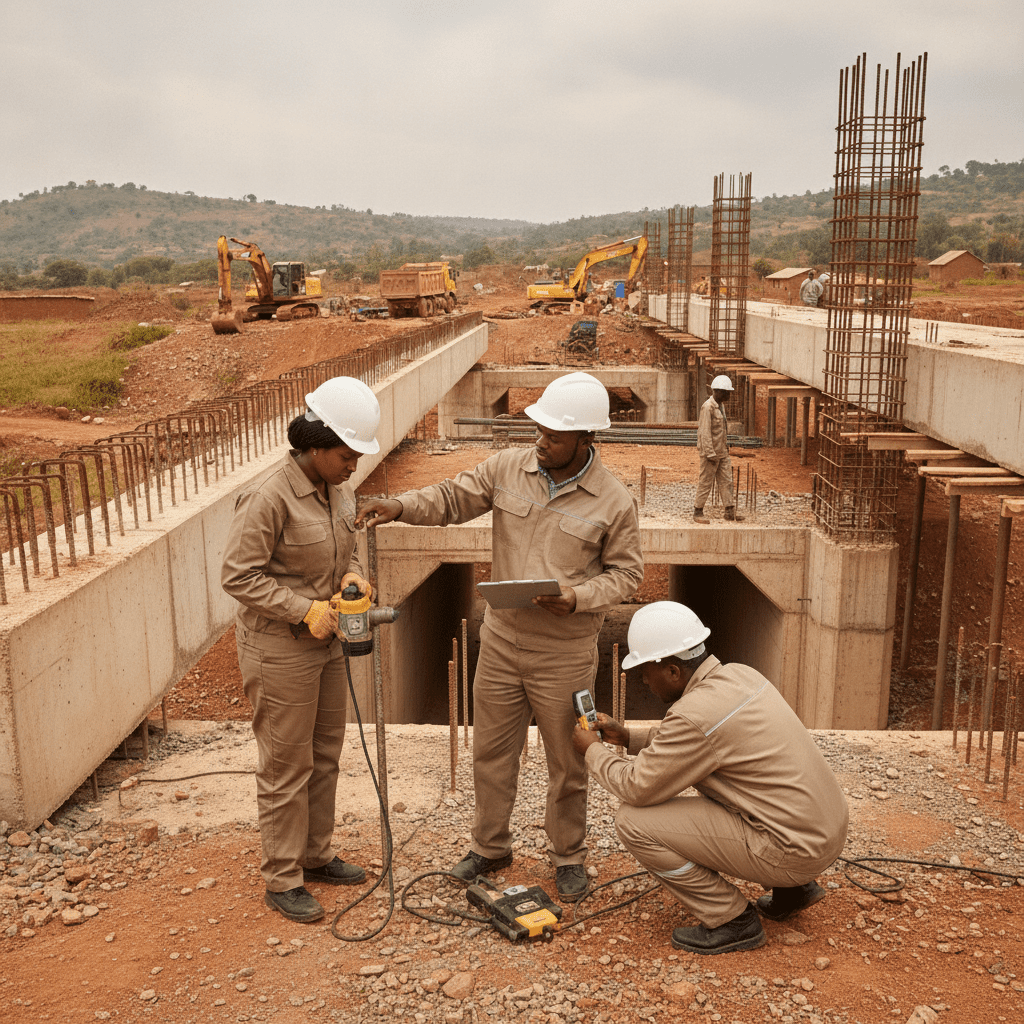
The Comprehensive Bridge and Culvert Assessment Process
| Common Oversight in Assessments | Recommended Practice for Scope Definition |
|---|---|
| Relying solely on visual inspection without quantitative data. | Integrate NDT and DT to quantify material properties and internal defects. |
| Ignoring environmental factors specific to the region. | Tailor investigation methods to address local challenges like coastal corrosion or scour. |
| Assuming original design loads are still applicable. | Re-evaluate load capacity against current and projected traffic demands. |
| Underestimating the impact of minor defects on long-term performance. | Prioritise defects based on their potential for propagation and structural impact. |
| Focusing only on the superstructure, neglecting foundations. | Conduct thorough foundation inspections, especially in areas prone to scour or expansive soils. |
Key Factors Influencing Assessment Scope and Deliverables
Risks, Compliance, and Kenyan Context in Infrastructure Assessment
Frequently Asked Questions
What typically triggers a structural assessment for a bridge or culvert in Kenya?
Several factors can necessitate a structural assessment. These commonly include the age of the structure, especially if it exceeds its original design life or has not had regular inspections. Visible signs of distress such as large cracks, spalling concrete, exposed and corroding reinforcement, or significant settlement are immediate triggers. Changes in environmental conditions, like increased frequency or severity of flooding, can prompt a scour assessment. Furthermore, a proposed increase in traffic volume or axle loads, or a regulatory requirement following a major incident in the vicinity, often mandates a comprehensive evaluation of the structure’s remaining capacity and safety margins. Asset owners are also increasingly adopting proactive, periodic assessment schedules to manage risk and plan maintenance.
How long does a typical bridge or culvert assessment process take?
The duration of a bridge or culvert assessment varies significantly based on the structure’s size, complexity, accessibility, and the scope of testing required. A basic visual inspection of a small culvert might take a few hours on site, with a preliminary report issued within days. However, a comprehensive assessment of a multi-span bridge involving extensive non-destructive testing, material sampling, structural analysis, and detailed reporting can extend over several weeks or even months. Factors such as weather conditions, site access constraints, and the need for specialized equipment or traffic management also influence the timeline. The final report compilation and peer review typically add to the overall duration.
What are the key structural components examined during an assessment?
A thorough bridge or culvert assessment systematically examines all critical structural components. For bridges, this includes the superstructure (deck slab, girders, trusses, parapets), the substructure (piers, abutments, columns), and the foundations (piles, footings, spread foundations). For culverts, the barrel (pipe or box section), headwalls, wingwalls, and invert are key. Engineers also inspect bearing pads, expansion joints, drainage systems, and approach slabs. Beyond the visible elements, the waterway or channel beneath is assessed for scour, debris accumulation, and changes in hydraulic conditions. Material condition, including concrete quality, steel corrosion, and timber decay, is also a primary focus, often requiring detailed testing.
What kind of report is issued after a structural assessment, and what does it include?
Upon completion of a structural assessment, a detailed engineering report is issued, providing a comprehensive overview of the structure’s condition. This report typically includes an executive summary, a description of the structure, methodology used for inspection and testing, and detailed findings from visual observations and all conducted tests. It will feature photographic evidence of defects, crack mapping, material test results (e.g., concrete strength, rebar analysis), and structural analysis calculations to determine remaining load-bearing capacity. Crucially, the report provides clear conclusions regarding the structure’s integrity and safety, along with specific, actionable recommendations for repair, strengthening, rehabilitation, or future monitoring. It also highlights any immediate safety concerns that require urgent attention.
Key Takeaways
Ensuring the longevity and safety of Kenya’s vital bridge and culvert infrastructure requires diligent oversight and expert evaluation. The key takeaways from understanding structural assessments include:
- Regular structural assessments are crucial for the long-term safety, operational efficiency, and structural integrity of bridges and culverts across Kenya, mitigating risks from environmental factors and increased traffic loads.
- Timely assessments should be initiated following severe weather events, observed damage, changes in usage patterns, or at prescribed intervals based on the structure’s age and design life, ensuring proactive maintenance.
- Comprehensive assessments encompass various elements including the superstructure (deck, beams), substructure (piers, abutments), foundations, and the hydraulic performance of waterways, identifying both visible and hidden defects.
- Advanced investigation techniques such as Non-Destructive Testing (NDT), material sampling, and load testing provide critical data to accurately determine the current condition, remaining capacity, and rehabilitation requirements of the infrastructure.
- Adherence to engineering standards and regulatory guidelines is paramount throughout the assessment process, ensuring that findings are robust, recommendations are sound, and any proposed interventions meet Kenyan safety and performance criteria.
- Neglecting professional structural assessments can lead to accelerated deterioration, unexpected failures, significant repair costs, public safety hazards, and disruptions to vital transportation networks, impacting economic activity.
- Detailed reporting is an essential output, providing a clear understanding of defects, their severity, root causes, and a prioritized list of recommended remedial actions, guiding effective maintenance and repair strategies.
- Proactive planning for maintenance and rehabilitation based on assessment findings extends the service life of these critical assets, optimizing public expenditure and ensuring the continued reliability of Kenya’s infrastructure.
For expert structural assessments of bridges and culverts, ensuring safety and compliance, please connect with a qualified engineering professional:
Phone: +254 719 532 233
Email: info@Cadreatech.com
Website: Cadreatech.com
