
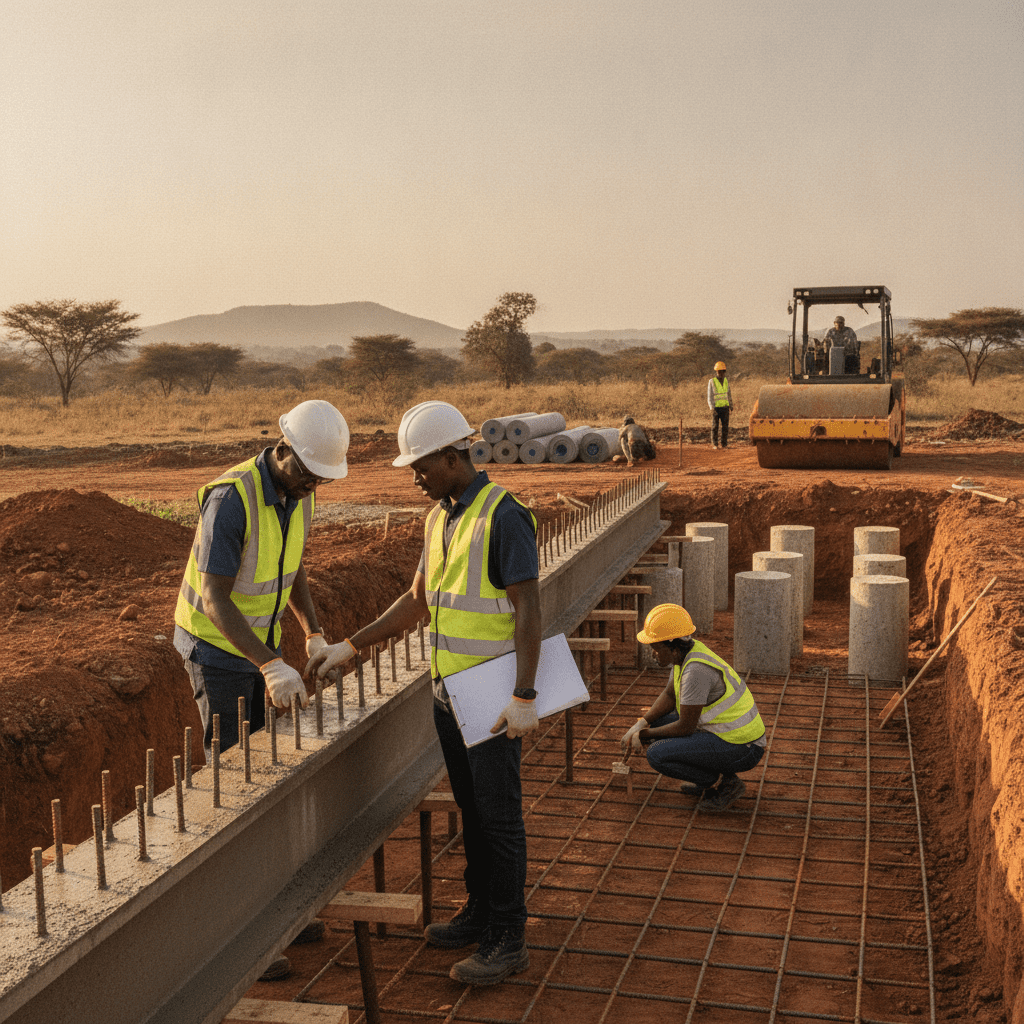
Ground Improvement in Kenya: Stabilisation vs. Deep Foundations
Kenya’s diverse geological landscape presents significant challenges for construction and infrastructure development. From the expansive black cotton soils prevalent in areas like Nairobi and Kajiado to the liquefaction-prone sands along the coast in Mombasa, and the variable murram and silty clays found across the country, engineers frequently encounter problematic ground conditions. These conditions can compromise the stability of structures, lead to excessive settlement, or result in differential movement, demanding robust foundation solutions. While deep foundations such as piles and piers are often considered, ground improvement techniques offer an alternative by enhancing the existing soil’s engineering properties, providing a more sustainable and sometimes more economical solution.
Understanding Kenya’s Challenging Soil Conditions
The varied geology across Kenya mandates a nuanced approach to foundation design, beginning with comprehensive site characterisation. Engineers must critically assess the specific soil profiles, their physical properties, and their potential behaviour under proposed structural loads. Key problematic soil types encountered include:
- Black Cotton Soils: These highly expansive clays, common in Nairobi, Kajiado, and parts of the Rift Valley, exhibit significant volume changes with variations in moisture content. They swell when wet and shrink when dry, leading to severe cracking and differential settlement in structures built directly upon them. Foundations on black cotton soil require specific design considerations to mitigate these movements, often involving isolating the foundation from the active zone or modifying the soil itself.
- Murram: A common lateritic soil found across many regions, murram can range from a stiff, well-draining material to a highly weathered, relatively soft soil. Its strength and permeability can be highly variable, necessitating careful evaluation to determine its load-bearing capacity and suitability for foundation support. Incorrect classification or inadequate testing of murram can lead to unexpected settlement or bearing capacity failures.
- Coastal Sands and Silts: Along the Kenyan coast, particularly in Mombasa and Kilifi, sandy and silty deposits are prevalent. These soils can be prone to liquefaction under seismic loading, especially if loose and saturated. Additionally, the presence of saline groundwater introduces a risk of corrosion to buried concrete and steel, requiring durable material specifications and protective measures for foundations.
- Soft Clays and Silts: Often found in low-lying areas, river valleys, and lakebeds (such as around Kisumu), these soils typically have low shear strength and high compressibility. Structures built on such soils are susceptible to large settlements over extended periods, making ground improvement techniques critical for reducing consolidation and enhancing stability.
The importance of a thorough geotechnical investigation cannot be overstated. This process involves drilling boreholes, conducting in-situ tests, and performing laboratory analyses to accurately classify soils, determine their engineering parameters, and predict their behaviour. Without this fundamental understanding, foundation designs risk being either over-engineered, leading to unnecessary costs, or under-engineered, resulting in structural distress and potential failure. Such investigations inform whether traditional deep foundations are necessary or if ground improvement offers a viable and more efficient solution.
| Compliance Requirement | Impact of Non-Compliance |
|---|---|
| Detailed Geotechnical Report | Risk of inadequate design leading to structural failure or excessive settlement. |
| County Building Permit Approval | Construction halts, fines, or demolition orders; project timeline disruption. |
| Adherence to KEBS Standards | Use of substandard materials, compromising the long-term durability and safety. |
| Qualified Engineering Supervision | Poor execution of ground improvement, leading to ineffective soil stabilisation. |
Principles of Ground Improvement and Soil Stabilisation
Ground improvement refers to a suite of techniques designed to enhance the engineering properties of in-situ soils, making them more suitable for supporting structures. This often involves increasing strength, reducing compressibility, improving drainage characteristics, or mitigating liquefaction potential. Unlike deep foundations, which bypass problematic soil layers to transfer loads to deeper, stronger strata, ground improvement directly treats the existing soil, transforming it into a more reliable foundation material.
The decision to opt for ground improvement over deep foundations is often driven by several factors, including the nature of the problematic soil, the type and magnitude of the proposed structure’s loads, site accessibility, environmental considerations, and project timelines. In many Kenyan contexts, particularly with widespread black cotton soils, stabilisation techniques can be more cost-effective and environmentally friendly than extensive piling operations.
Key ground improvement techniques commonly employed or considered in Kenya include:
- Mechanical Compaction: This involves densifying loose soils through various methods like vibratory rollers, dynamic compaction (dropping heavy weights), or vibro-flotation. It increases the soil’s density and shear strength, reducing settlement and improving resistance to liquefaction. This is particularly effective for granular soils.
- Chemical Stabilisation: This method involves mixing additives like lime, cement, or fly ash with problematic soils to alter their properties.
- Lime Stabilisation: Highly effective for plastic clays, including black cotton soils. Lime reacts with clay minerals to reduce plasticity, increase strength, and decrease swelling potential. This is a common strategy after a comprehensive Professional Black Cotton Soil Assessment reveals the presence of highly expansive clays.
- Cement Stabilisation: Suitable for a broader range of soils, cement binds soil particles together, forming a semi-rigid or rigid matrix. This significantly increases compressive strength, stiffness, and durability.
- Geosynthetics: Geotextiles, geogrids, and geomembranes are synthetic materials used to reinforce soils, separate different soil layers, filter water, or provide drainage. Geogrids, for instance, can be used to improve the bearing capacity of shallow foundations by confining the soil and distributing loads over a wider area, effectively creating a composite soil-reinforcement system.
- Vibro-Replacement (Stone Columns): In this technique, a vibrator penetrates the soil, creating a cavity that is then backfilled with coarse aggregate (stones). These stone columns densify surrounding granular soils and reinforce cohesive soils, improving bearing capacity, reducing settlement, and accelerating consolidation.
- Preloading and Vertical Drains: For highly compressible soft clays, preloading involves placing a temporary surcharge load on the ground surface to induce consolidation settlement before construction. Vertical drains (e.g., wick drains or sand drains) are often installed to shorten the drainage path, accelerating the consolidation process significantly.
The selection of an appropriate ground improvement technique is a meticulous process that requires detailed knowledge of soil mechanics, site-specific conditions, and the performance characteristics of each method. Engineers must assess the long-term effectiveness, constructability, and interaction with the proposed structure to ensure a safe and durable foundation system.
The choice between ground improvement and deep foundations is not always clear-cut and often involves a detailed comparative analysis. Ground improvement can often provide a more uniform foundation bed, reducing differential settlement, and can be particularly advantageous for large-area developments or infrastructure projects where the cost of individual deep foundations would be prohibitive. Moreover, by improving the existing soil, it often reduces the need for extensive excavation and off-site disposal of unsuitable material, contributing to a more sustainable construction practice.
Effective ground improvement begins with a deep understanding of the existing soil conditions and the engineering demands of the proposed structure. The primary objective is to enhance the soil’s engineering properties, such as bearing capacity, shear strength, and stiffness, while reducing compressibility and susceptibility to volume changes. This preparatory phase is often more cost-effective and sustainable than relying solely on deep foundation systems, particularly when dealing with widespread problematic soils.
A crucial first step involves comprehensive geotechnical investigation. This process typically includes drilling boreholes, excavating trial pits, and conducting various in-situ tests like Standard Penetration Tests (SPT) or Cone Penetration Tests (CPT). These investigations provide critical data on soil stratification, groundwater levels, and preliminary strength parameters. Following field investigations, detailed soil classification and laboratory testing are performed. This involves determining key properties such as Atterberg limits, grain size distribution, unconfined compressive strength, consolidation characteristics, and chemical composition. For instance, the presence of sulfates or organic matter can significantly influence the selection and effectiveness of chemical stabilisation methods. The results from these analyses form the bedrock for designing an appropriate ground improvement strategy.
Several ground improvement techniques are commonly employed in Kenya, each suited to specific soil types and project requirements:
- Mechanical Stabilisation: This category primarily involves physical alteration of the soil structure. Compaction, using heavy rollers or vibratory compactors, is effective for granular soils and engineered fills to increase density and reduce voids. Dynamic compaction, where heavy weights are repeatedly dropped onto the ground, can improve deeper loose granular soils. Soil replacement, involving the excavation of problematic shallow soil and backfilling with engineered material like murram or graded aggregates, is a direct mechanical method often used for foundations on soft clays or highly expansive soils. Vibro-compaction or vibro-flotation techniques use vibrating probes to densify loose, cohesionless soils, often combined with aggregate columns to enhance load transfer.
- Chemical Stabilisation: This involves mixing chemical additives with the soil to induce physicochemical reactions that alter its properties. Lime stabilisation is highly effective for plastic clays, particularly black cotton soil prevalent in areas like Nairobi, Kisumu, and Kajiado. The lime reacts with clay minerals, reducing plasticity, increasing strength, and making the soil less susceptible to volume changes. Cement stabilisation, using Ordinary Portland Cement, is suitable for a wider range of soils, including sandy clays and silts, creating a cemented matrix that significantly increases strength and stiffness. Other pozzolanic materials like fly ash or ground granulated blast-furnace slag can also be used, often in combination with lime or cement, to improve soil properties and sustainability.
- Geosynthetic Reinforcement: Geotextiles, geogrids, and geocells are synthetic materials used to improve soil performance. Geotextiles can provide separation, filtration, and drainage functions, preventing intermixing of different soil layers and facilitating water movement. Geogrids offer tensile reinforcement, commonly used in retaining walls, steepened slopes, and road bases to distribute loads and prevent shear failure. Geocells, three-dimensional cellular confinement systems, enhance the performance of granular fills and subbases by confining particles and increasing their stiffness.
A typical chemical stabilisation project, for instance, follows a methodical process:
- Detailed Geotechnical Investigation and Laboratory Testing: Comprehensive site investigation to classify soils, determine engineering properties, and identify problematic layers. Laboratory tests establish initial soil parameters and guide preliminary additive selection.
- Design Mix Proportioning and Optimisation: Laboratory trials are conducted to determine the optimal percentage of additives (e.g., lime, cement) required to achieve target strength, plasticity, and durability. This phase is crucial for cost-effectiveness and performance.
- Site Preparation: The site is cleared of vegetation, debris, and any unsuitable topsoil. The area to be treated is then accurately surveyed and marked.
- Additive Spreading and Initial Mixing: The calculated amount of stabilising agent is uniformly spread over the soil surface using specialised spreaders. Initial mixing can be done with agricultural plows or rotary mixers to achieve a preliminary blend.
- Water Application and Final Mixing: Water is added to achieve the optimum moisture content necessary for the chemical reaction and subsequent compaction. High-capacity rotary mixers or pulverisers then thoroughly blend the soil, additive, and water to create a homogenous mix to the specified depth.
- Compaction and Curing: The stabilised layer is compacted immediately after mixing to achieve the design density using appropriate compaction equipment (e.g., vibratory rollers). The compacted layer is then protected and allowed to cure for a specified period, typically 7 to 28 days, during which the chemical reactions continue to develop strength.
- Quality Control Testing: Throughout the process, quality control tests are performed. These include density checks during compaction, and unconfined compressive strength tests on cured samples to confirm that the design strength has been achieved. In-situ Plate Load Tests or Dynamic Cone Penetrometer (DCP) tests may also be conducted on the treated layer to verify bearing capacity.
The selection of an appropriate ground improvement technique is a multifaceted decision, balancing technical feasibility, project requirements, site constraints, and regulatory compliance. It is rarely a one-size-fits-all solution, especially within Kenya’s diverse geological and environmental landscape. A thorough evaluation by a qualified geotechnical engineer is essential to ensure long-term performance and safety.
Several critical factors influence the choice and successful implementation of ground improvement solutions:
- Soil Type and Properties: This is arguably the most significant factor. Highly plastic clays, such as black cotton soil, respond well to lime stabilisation, while loose sands benefit more from mechanical densification like vibro-compaction. Organic soils may require complete replacement or specific chemical treatments due to their complex composition. The plasticity index, moisture content, shear strength, and consolidation characteristics all guide the engineer toward suitable methods.
- Project Load and Performance Requirements: The magnitude and type of load imposed by the structure (e.g., light residential, heavy industrial, bridge abutment) dictate the required improvement in bearing capacity and the tolerable settlement limits. High-rise buildings will demand more robust ground improvement or deep foundations than single-storey structures.
- Site Constraints and Environmental Considerations: Limited site access, proximity to existing sensitive structures, and the presence of high groundwater tables can restrict the applicability of certain techniques. For instance, dynamic compaction may not be suitable near existing buildings due to vibrations. Environmental impact, such as dust generation or the potential for chemical leaching, must also be assessed, particularly in urban or ecologically sensitive areas.
- Availability of Materials and Equipment: The local availability and cost-effectiveness of stabilising agents (lime, cement, aggregates) and specialized equipment (spreaders, mixers, compactors) play a practical role in decision-making. In remote areas of Kenya, logistics for material delivery can influence the preferred method.
Effective ground improvement also necessitates adherence to local regulatory frameworks and county-specific requirements. In Kenya, engineering designs must comply with national building codes and are subject to approval by relevant county governments. A registered engineer’s involvement in the design, supervision, and quality assurance phases is mandatory to ensure compliance and structural integrity. Counties like Nairobi, with its rapid urbanisation and varied geology including expansive clays and weathered rocks, often require detailed geotechnical reports and stringent adherence to design specifications. Mombasa, with its coastal environment, faces challenges related to saline intrusion, high water tables, and potential corrosion, which influence the choice of materials and protection measures in ground improvement. Kisumu, similarly, grapples with extensive black cotton soil deposits and high rainfall, demanding robust stabilisation and drainage solutions.
The consequences of substandard ground improvement are substantial. These include differential settlement leading to structural distress, cracking in walls and foundations, and premature deterioration of buildings. Inadequate bearing capacity can result in catastrophic structural collapse, posing significant safety risks. Furthermore, non-compliance with engineering standards can lead to legal ramifications and difficulties in obtaining occupancy certificates. Investing in proper ground improvement and qualified engineering supervision from the outset is a critical safeguard against these costly and dangerous outcomes.
The successful implementation of ground improvement techniques in Kenya is inextricably linked to adherence to regulatory frameworks and a proactive approach to managing inherent geotechnical risks. Kenya’s diverse geological landscape, from the expansive black cotton soils of Nairobi and Kajiado to the coastal sands and silts of Mombasa, presents a unique set of challenges that demand rigorous investigation and compliance with established engineering standards. Skipping professional geotechnical input or neglecting regulatory requirements can lead to significant structural integrity issues, project delays, and substantial financial repercussions.
Engineers operating in Kenya must be conversant with the Kenya Building Code and relevant standards issued by the Kenya Bureau of Standards (KEBS) that govern construction materials and practices. These regulations provide a baseline for design and execution, ensuring public safety and structural longevity. Beyond national codes, county-specific planning and building control departments, such as those in Nairobi City County, Mombasa County, or Kisumu County, have their own approval processes and requirements for construction permits, which often include detailed geotechnical reports and proposed ground improvement methodologies. Failure to secure these approvals can halt a project indefinitely or lead to demolition orders.
Geotechnical risks in Kenya are varied. Expansive clays, commonly known as black cotton soils, exhibit significant volume changes with moisture content fluctuations, leading to differential settlement and cracking in structures if not properly stabilised. Collapsible soils, often found in arid and semi-arid regions, can undergo sudden volume reduction upon wetting, jeopardising foundations. High water tables, particularly in coastal areas or near major lakes and rivers, introduce challenges related to bearing capacity reduction, liquefaction potential, and corrosion of buried infrastructure. Addressing these risks requires a thorough understanding of site-specific conditions, typically obtained through comprehensive geotechnical investigations.
The process for ensuring compliance and mitigating risks in ground improvement projects typically follows a structured approach:
- Initial Site Assessment and Desktop Study: Reviewing existing geological maps, historical data, and previous reports to understand the general site conditions and potential hazards.
- Detailed Geotechnical Investigation: Conducting boreholes, trial pits, in-situ tests (e.g., SPT, CPT), and laboratory testing (e.g., soil classification, consolidation, shear strength) to characterise the soil profile, groundwater conditions, and engineering properties. This stage is crucial for identifying specific soil challenges like expansive clays, as detailed in a professional black cotton soil assessment.
- Selection of Appropriate Ground Improvement Technique: Based on the geotechnical findings, the structural loads, and project constraints, an optimal ground improvement method (e.g., dynamic compaction, vibro-compaction, stone columns, chemical stabilisation) is selected.
- Design and Engineering: Developing detailed designs for the chosen ground improvement solution, incorporating local codes, safety factors, and performance criteria. This includes specifying material properties, treatment depths, and quality control measures.
- Obtaining County Approvals: Submitting comprehensive geotechnical reports, design drawings, and proposed methodologies to the relevant county planning and building control departments for review and approval. This often involves engagement with county engineers and planners.
- Supervision and Quality Control during Implementation: Continuous monitoring and testing during the ground improvement works to ensure compliance with design specifications. This includes verifying material quality, compaction efforts, and treatment depths.
- Post-Construction Monitoring: In some cases, long-term monitoring of settlement or ground movement may be recommended, especially for large structures or challenging ground conditions, to confirm the long-term efficacy of the improvement.
Ignoring regulatory requirements or neglecting thorough geotechnical investigations for ground improvement can lead to severe ramifications. These include significant structural damage from differential settlement, project delays due to halted construction, costly rework, potential legal liabilities, and a compromised safety record for the development.
The table below highlights critical aspects of compliance and risk management in ground improvement projects in Kenya:
| Common Soil Issue | Typical Ground Improvement Strategy |
|---|---|
| Expansive Black Cotton Soil (high plasticity) | Lime stabilisation or deep soil mixing to reduce plasticity and swelling. |
| Loose Granular Sands (liquefaction risk) | Vibro-compaction or dynamic compaction to increase density. |
| Soft, Compressible Clays (high settlement) | Preloading with vertical drains or stone columns to accelerate consolidation. |
| Weak or Variable Murram (low bearing capacity) | Cement stabilisation or geosynthetic reinforcement to enhance strength. |
Principles and Methodologies of Ground Improvement
| Common Oversight in Ground Improvement | Recommended Practice for Optimal Results |
|---|---|
| Reliance on visual assessment of soil only. | Conduct comprehensive geotechnical investigations and laboratory testing. |
| Using generic additive percentages for chemical stabilisation. | Perform lab-optimised design mix trials for specific site soils. |
| Inadequate compaction or mixing depth. | Ensure uniform mixing and compaction to specified depths and densities. |
| Ignoring groundwater presence during design and construction. | Integrate dewatering or drainage solutions where high water tables exist. |
| Lack of continuous quality control testing during execution. | Implement a rigorous quality assurance/quality control plan with regular testing. |
| Failure to consider long-term environmental factors like rainfall. | Incorporate adequate surface and subsurface drainage for durability. |
Selecting and Implementing Optimal Ground Improvement Solutions
Navigating Regulatory Compliance and Geotechnical Risks in Kenya
Ensuring that all aspects of ground improvement, from initial investigation to final implementation, are carried out by qualified professionals in strict accordance with Kenyan regulations is paramount for the safety, durability, and economic viability of any construction project.
Frequently Asked Questions
What is the fundamental difference between ground improvement and deep foundations?
Ground improvement techniques modify the existing soil properties to enhance its bearing capacity, reduce settlement, or mitigate other undesirable characteristics, making it suitable to support shallow foundations or light structures. This involves methods like compaction, chemical stabilisation, or the installation of stiff inclusions like stone columns. Deep foundations, conversely, bypass problematic shallow soil layers by transferring structural loads to stronger, deeper strata or rock formations using piles, caissons, or drilled shafts. The choice between the two depends on factors such as the depth and extent of unsuitable soil, the magnitude of structural loads, site constraints, and the desired performance criteria. Ground improvement often proves more economical and less intrusive when the problematic soil layer is relatively shallow or when a moderate increase in bearing capacity is sufficient.
What key factors determine the choice of ground improvement technique in Kenya?
The selection of an appropriate ground improvement technique in Kenya is influenced by several critical factors. Primarily, the specific soil characteristics (e.g., type, strength, compressibility, permeability, presence of expansive clays or collapsible soils) and groundwater conditions are paramount. Secondly, the nature and magnitude of the proposed structural loads and the allowable settlement dictate the required improvement level. Site constraints, such as proximity to existing structures, access limitations, and environmental considerations (e.g., dust, noise, vibration), also play a significant role. Furthermore, the availability of materials and equipment, construction timelines, and the overall project budget (in terms of scope and resource allocation, not specific monetary values) guide the decision-making process. A thorough geotechnical investigation is essential to inform this selection.
How do local soil conditions like black cotton influence ground improvement decisions?
Black cotton soils, prevalent in many parts of Kenya, are expansive clays that exhibit significant shrink-swell behaviour with changes in moisture content. This characteristic makes them highly problematic for conventional shallow foundations, as they can cause severe differential settlement and cracking. When dealing with black cotton soils, ground improvement decisions often focus on mitigating their expansive nature. Techniques might include chemical stabilisation (e.g., lime or cement stabilisation) to reduce plasticity and swelling potential, pre-wetting and surcharge to induce settlement before construction, or the use of geosynthetics to isolate the foundation from the active zone. In some cases, partial replacement of the expansive soil with non-expansive material might be considered. The goal is to create a stable, non-reactive layer beneath the foundation.
What is the typical timeline for a ground improvement project from assessment to completion?
The timeline for a ground improvement project in Kenya is highly variable and depends on the project’s scale, complexity, and the chosen technique. Generally, the initial geotechnical investigation phase, including fieldwork and laboratory testing, can take anywhere from 2 to 6 weeks, depending on the number of boreholes and tests required. The subsequent design and engineering phase, which incorporates the investigation findings, might last another 3 to 8 weeks. Securing county approvals can be a lengthy process, often ranging from 2 to 4 months, though this can vary significantly by county and project. The actual implementation of the ground improvement technique on-site can take from a few weeks for smaller, straightforward projects (e.g., localised compaction) to several months for larger, more complex interventions involving extensive deep stabilisation or vibro-compaction over a large area. Post-construction monitoring, if required, adds to the overall duration.
To optimise project timelines and avoid costly delays, engage a qualified geotechnical engineer early in the planning phase. Early assessment allows for informed decision-making regarding ground improvement, streamlines the design process, and proactively addresses potential regulatory hurdles, ensuring a smoother project progression.
Key Takeaways
- Site-Specific Assessment is Paramount: Effective ground improvement begins with a comprehensive geotechnical investigation to accurately characterise soil conditions, identify problematic layers, and determine appropriate stabilisation methods. This diagnostic step avoids generic solutions and ensures engineering suitability, particularly for varied terrains across Kenya.
- Ground Improvement as a Viable Alternative: For sites with challenging near-surface soils such as expansive clays (e.g., black cotton soil prevalent in Kajiado and parts of Nairobi) or loose, collapsible sands, ground improvement often presents a more economical and sustainable solution than traditional deep foundations, especially for structures with moderate load requirements.
- Technique Selection is Critical: The choice of ground improvement method, whether it involves mechanical compaction, chemical stabilisation (using lime, cement, or other binders), vibro-compaction, or the installation of stone columns, must be precisely tailored to the specific soil type, project requirements, and environmental considerations. Each technique has distinct applications and limitations that engineers must evaluate.
- Long-Term Performance and Sustainability: Properly executed ground improvement significantly enhances the bearing capacity, reduces total and differential settlement, and improves the shear strength of problematic soils. This leads to stable, durable structures and can contribute to a reduced carbon footprint compared to extensive concrete piling.
- Professional Engineering Supervision is Non-Negotiable: The design, implementation, and quality control of ground improvement techniques demand the expertise of qualified geotechnical and structural engineers. Their rigorous oversight ensures strict adherence to design specifications, relevant local building codes, and industry best practices, thereby mitigating future structural risks.
- Cost-Effectiveness Beyond Initial Investment: While initial costs for specialised ground improvement might require careful budgeting, these methods frequently lead to substantial overall project savings. This is achieved by reducing excavation volumes, optimising material usage, and accelerating construction timelines, ultimately delivering a more value-engineered foundation system.
- Understanding Kenyan Soil Dynamics: Engineers must critically account for regional soil variations found across Kenya, from the expansive clays of the Rift Valley and Athi River basin to the lateritic soils of Central Kenya and the saline or corrosive environments of the Coast. These local nuances are fundamental in designing the most effective and resilient ground improvement strategies.
Connect with Engineering Experts
For detailed guidance on ground improvement techniques tailored to your project’s specific needs and site conditions, connect with qualified professionals.
Phone: +254 719 532 233
Email: info@Cadreatech.com
Website: Cadreatech.com
Related Reading
- Professional Black Cotton Soil Assessment in Kenya for Long-Lasting Foundations
- Geotechnical investigation Nairobi — soil testing explained
- Soil Classification and Laboratory Testing
- Periodic building inspection Kenya — five-year rule under NBC
- Kenya National Building Code — what developers and engineers must comply with
