
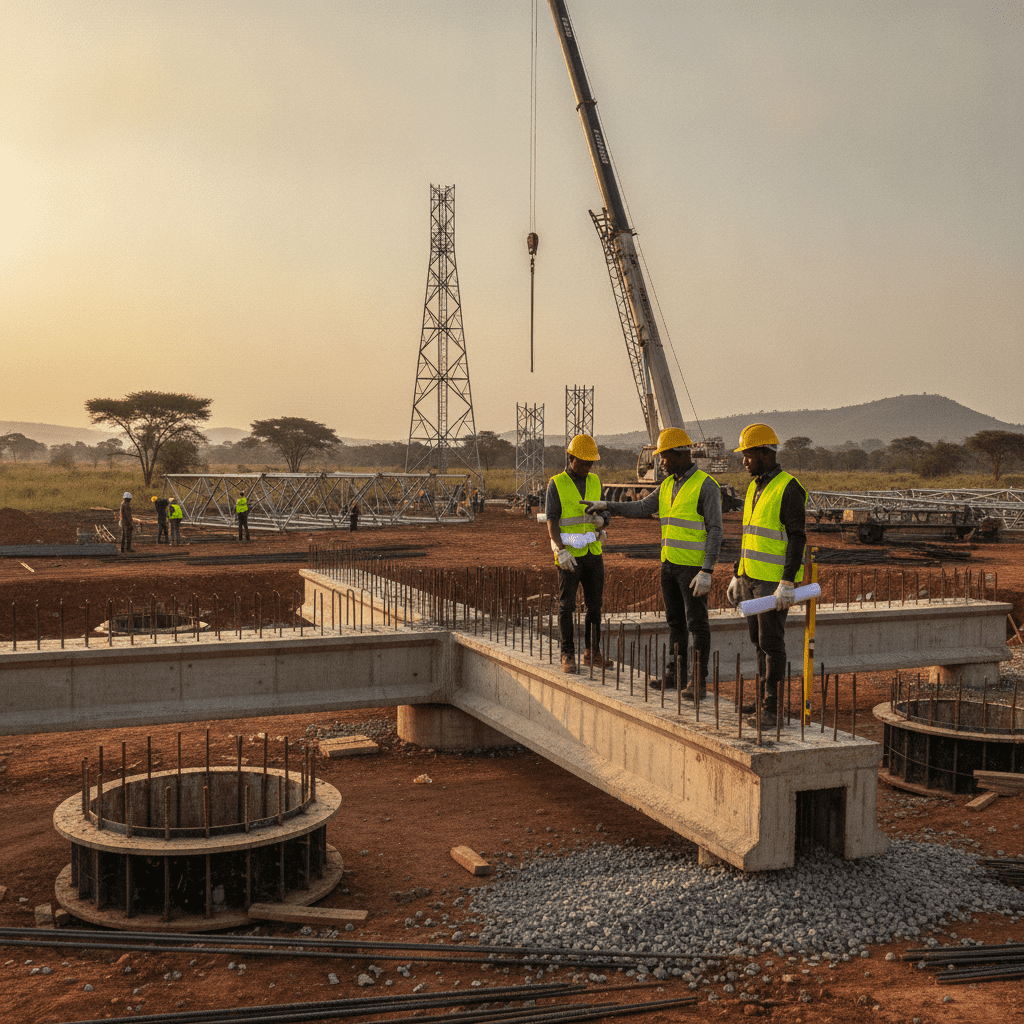
Telecom Tower Foundation Design: Geotechnical & Structural Basics Kenya
The rapid expansion of telecommunication networks across Kenya necessitates robust and reliable tower and mast foundations. From the bustling urban centres of Nairobi to the remote reaches of Turkana, these structures are critical for connectivity. However, the diverse geotechnical conditions prevalent across the country, coupled with varying environmental loads, present significant engineering challenges. A properly designed foundation is not merely a base; it is the primary safeguard against structural failure, ensuring uninterrupted service and safety throughout the tower’s operational lifespan. Understanding the fundamental geotechnical and structural principles is paramount for engineers and developers embarking on such projects in Kenya.
Geotechnical Investigation for Tower Foundations
The stability and longevity of any telecommunication tower foundation are fundamentally dependent on a comprehensive understanding of the underlying soil conditions. In Kenya, this is particularly crucial due to the country’s varied geology, ranging from expansive black cotton soils in parts of Nairobi and Kajiado to lateritic murram in central regions, and unconsolidated sands and coral formations along the coast. A thorough geotechnical investigation is the indispensable first step, informing the selection of the most appropriate and economical foundation type.
This process typically commences with a detailed desktop study, reviewing existing geological maps, historical data, and satellite imagery to identify potential risks such as fault lines, flood plains, or areas prone to erosion. This is followed by intrusive site investigations, which involve drilling boreholes to specific depths, often ranging from 15 to 30 metres, depending on the tower height and anticipated loads. During drilling, engineers collect disturbed and undisturbed soil samples for laboratory analysis. Crucially, in-situ tests like the Standard Penetration Test (SPT) are performed at regular intervals within the boreholes to assess soil density, consistency, and indirectly, bearing capacity. For soft clays and silts, Cone Penetration Tests (CPT) may also be employed for continuous profiling.
Laboratory tests on collected samples provide critical parameters, including moisture content, Atterberg limits (liquid and plastic limits) for cohesive soils, particle size distribution, shear strength parameters (cohesion and angle of internal friction), and consolidation characteristics. For expansive soils like black cotton found in areas around Athi River and parts of Kisumu, swell potential tests are vital to predict volume changes that could exert significant uplift pressures or cause differential settlement. The presence and fluctuation of the groundwater table also play a profound role. A high water table can reduce effective stress, leading to lower bearing capacity and potential liquefaction in loose granular soils during seismic events. Coastal regions, such as Mombasa and Kilifi, require special attention to corrosive groundwater and the potential for saltwater intrusion affecting concrete durability.
The outcome of this detailed investigation is a comprehensive geotechnical report. This document provides a detailed subsurface profile, classifies the soil and rock strata, determines critical engineering properties, assesses the groundwater regime, and, most importantly, recommends suitable foundation types, design parameters, and potential construction challenges. Ignoring or conducting a superficial geotechnical investigation is a common oversight that can lead to unforeseen settlement, tilting, or even catastrophic failure of the tower structure, jeopardizing public safety and network continuity. For detailed insights into local soil testing practices, engineers often refer to comprehensive guides like Geotechnical Investigation Nairobi — Soil Testing Services.
Always ensure robust surface drainage systems are incorporated into the overall site design around telecommunication tower foundations. Effective grading and the installation of swales or French drains can divert rainwater away from the foundation perimeter, preventing saturation of the underlying soil, minimizing erosion, and mitigating the risks associated with expansive clay soils found in many parts of Kenya, such as those in Machakos or parts of Kisumu.
| Common Oversight in Foundation Design | Recommended Practice for Telecom Tower Foundations |
|---|---|
| Assuming uniform soil conditions across the site without verification. | Conducting multiple boreholes and in-situ tests to map soil strata variability accurately. |
| Underestimating wind loads or neglecting dynamic wind effects on tall structures. | Performing detailed wind load analysis, considering terrain category, height, and gust factors as per relevant codes. |
| Ignoring the potential for seismic activity in areas prone to tremors. | Incorporating seismic design principles and detailing, especially in the Rift Valley region. |
| Lack of corrosion protection for embedded steel in aggressive soil or coastal environments. | Specifying appropriate protective coatings, galvanisation, or using corrosion-resistant materials. |
| Insufficient consideration of constructability, access, and material logistics for remote sites. | Integrating construction methodology and site constraints into the foundation design from the outset. |
| Failure to account for future upgrades or increased antenna loads on the tower. | Designing with a reasonable factor of safety and potential for load increases to avoid premature obsolescence. |
Structural Design Principles for Tower Foundations
Once the geotechnical characteristics of a site are thoroughly understood, the structural design phase commences, translating the soil parameters and applied loads into a safe and efficient foundation system. The choice of foundation type for a telecommunication tower is dictated by the magnitude of axial loads, overturning moments, shear forces, and the specific bearing capacity of the soil. Common foundation types include isolated pad foundations for smaller masts, combined footings for guyed towers, raft foundations for poor soil conditions or heavy self-supporting towers, and piled foundations where very weak soils extend to significant depths or where uplift resistance is critical.
The design process begins with a rigorous analysis of all anticipated loads. Dead loads include the weight of the tower structure itself, antennas, and ancillary equipment. Live loads account for maintenance personnel and temporary equipment. Crucially, wind loads are often the dominant design consideration for tall, slender structures like telecom towers, especially in open, exposed areas across the Rift Valley or coastal regions where wind speeds can be substantial. Seismic loads, though less frequent, must also be evaluated, particularly in seismically active zones within Kenya, such as parts of the Rift Valley. Engineers must consider both ultimate limit states (ULS) for strength and serviceability limit states (SLS) for deflection and vibration, ensuring the foundation can withstand extreme events without collapse and perform adequately under normal operating conditions without excessive movement.
Stability checks are paramount. The foundation must be designed to resist overturning, primarily caused by wind-induced moments, by ensuring a sufficient factor of safety against uplift. Similarly, resistance to sliding, induced by horizontal wind shear forces, must be confirmed by mobilizing adequate passive earth pressure and friction at the foundation base. The most critical check involves ensuring the ultimate bearing capacity of the soil is not exceeded under any load combination, with appropriate factors of safety applied to prevent catastrophic settlement or shear failure. Differential settlement must also be meticulously controlled to prevent tower tilt, which can compromise antenna alignment and structural integrity.
Reinforced concrete is the material of choice for most tower foundations due to its strength, durability, and cost-effectiveness. The design of the concrete section and reinforcement detailing must adhere to relevant structural codes, such as BS 8110 or Eurocodes, which are widely adopted in Kenyan engineering practice. This includes specifying adequate concrete strength (e.g., C25/30 or C30/37), proper cover to reinforcement to protect against corrosion (especially critical in coastal areas like Lamu or Mombasa), and robust anchorage systems to connect the tower base plate securely to the foundation. Poor detailing or inadequate concrete quality can lead to premature deterioration, cracking, and ultimately, foundation failure, which is why understanding foundation failure warning signs is crucial for ongoing maintenance and safety.
The successful deployment of a telecom tower in Kenya hinges critically on a robust foundation, which itself is a direct outcome of meticulous geotechnical investigation and structural design. This process is not a linear checklist but an iterative cycle of analysis, design, and review, ensuring the tower’s stability against dynamic forces like wind, seismic activity, and operational loads. Engineers initiate the process by understanding the proposed tower type, height, antenna count, and equipment loads, which dictate the required foundation capacity.
A comprehensive geotechnical investigation is the bedrock of any foundation design. In Kenya, this involves drilling boreholes or excavating trial pits to ascertain the soil profile, stratigraphy, and groundwater conditions. Different regions present unique challenges; for instance, black cotton soils prevalent in areas like parts of Kajiado and Kisumu require special considerations due to their expansive nature, necessitating deep foundations or soil stabilization techniques. Conversely, the murram soils found in many parts of Nairobi and central Kenya generally offer higher bearing capacities but still require careful evaluation for consistency and presence of underlying problematic layers. Coastal areas like Mombasa introduce challenges of corrosive environments and often sandy, loose soils with high water tables, requiring piled foundations and protection against sulphate attack.
The data gathered from the site investigation, including Standard Penetration Test (SPT) N-values, shear strength parameters, and consolidation characteristics, are then used to determine the soil’s bearing capacity and settlement potential. This information directly informs the choice of foundation type – be it a shallow pad foundation, a raft, or deep foundations like piles or caissons. For telecom towers, the overturning moment caused by wind is often the dominant design criterion, making the uplift capacity of the soil and the foundation’s resistance to overturning critical. Engineers employ advanced finite element analysis (FEA) or established analytical methods to model soil-structure interaction and predict performance under various load combinations.
Once the geotechnical parameters are established, the structural design phase commences. This involves sizing the foundation elements (e.g., concrete dimensions, reinforcement detailing) to safely transfer the tower loads to the ground. The design must adhere to relevant Kenyan building codes and international standards, ensuring adequate factors of safety against bearing failure, excessive settlement, and overturning. A qualified structural engineer will consider various load cases, including dead loads (tower weight, equipment), live loads (personnel, maintenance), wind loads (critical for tall structures), and seismic loads (especially in seismically active zones of Kenya). The interaction between the tower’s superstructure and the foundation is complex, requiring a holistic approach to ensure the entire system remains stable and serviceable throughout its design life.
The following outlines a typical step-by-step process for telecom tower foundation design and analysis:
- Site Reconnaissance and Data Collection: Initial visit to assess site accessibility, topography, existing infrastructure, and gather available geological maps or records.
- Geotechnical Investigation Planning: Define scope of work, including borehole locations, depths, and laboratory testing requirements based on tower height and anticipated loads.
- Field Investigation Execution: Conduct boreholes/trial pits, collect disturbed and undisturbed soil samples, perform in-situ tests like SPT or Cone Penetration Test (CPT).
- Laboratory Testing: Analyze soil samples for classification (e.g., Atterberg limits), shear strength (direct shear, triaxial), consolidation, and chemical properties (sulphates, chlorides).
- Geotechnical Analysis and Report: Interpret field and lab data to determine soil bearing capacity, settlement characteristics, uplift resistance, and provide foundation recommendations. This often includes a Geotechnical Investigation Nairobi — Soil Testing Services report detailing findings.
- Structural Load Determination: Calculate all anticipated loads on the foundation, including dead, live, wind (using local wind speed data), and seismic loads, as per design codes.
- Foundation Type Selection: Based on geotechnical recommendations and structural loads, select the most appropriate foundation type (e.g., pad, raft, pile, rock anchor).
- Detailed Structural Design: Design foundation dimensions, concrete strength, and reinforcement detailing to safely resist all factored loads, ensuring compliance with structural codes.
- Peer Review and Approval: Independent structural engineer reviews the design calculations and drawings to ensure accuracy, safety, and compliance before construction.
The selection of an appropriate foundation type for a telecom tower is a multifaceted decision influenced by several critical factors beyond just the immediate soil conditions. These include the specific tower type, its overall height and antenna configuration, the available space at the site, logistical challenges, and local regulatory requirements. For instance, a self-supporting lattice tower, common across Kenya, typically requires a robust spread footing or raft foundation to manage significant overturning moments. In contrast, a guyed mast might necessitate smaller concrete blocks for the mast base and separate anchor blocks for the guy wires, distributed over a larger footprint.
The height of the tower directly correlates with the wind loads it will experience, which in turn dictates the magnitude of overturning moments and shear forces transmitted to the foundation. Taller towers with multiple antenna arrays require foundations with greater resistance to uplift and overturning. Site accessibility is another practical concern; remote locations, often chosen for network coverage, might restrict the use of heavy machinery for deep piling or large concrete pours, favouring simpler, constructible solutions. The number and type of antennas also play a role, as they add to the dead load and increase the effective wind-exposed area, intensifying foundation demands.
Regional geological and environmental factors across Kenya significantly shape foundation design. In Nairobi and its environs, sites often feature varying soil strata, from weathered volcanic rocks to expansive clays or stable murram. Designs here must accommodate these variations, potentially using pad foundations on stable ground or piled foundations where competent bearing strata are deeper. For example, in areas with significant black cotton soil deposits, such as parts of Kajiado County, engineers often opt for deep pile foundations socketed into stable ground or employ ground improvement techniques to mitigate the soil’s expansive properties, preventing differential settlement and potential foundation failure warning signs Kenya — geotechnical and structural red flags.
In coastal regions like Mombasa, the presence of loose sands, high water tables, and corrosive saline environments necessitates careful design. Piled foundations are frequently employed to reach denser sand layers or bedrock, and concrete elements require specific mix designs and protective coatings to resist chloride and sulphate attack. Kisumu, situated near Lake Victoria, often deals with silty clays and fluctuating groundwater levels, which can impact bearing capacity and settlement. Here, considerations for buoyancy and potential liquefaction in loose saturated sands during seismic events may also arise, requiring careful evaluation of the Professional Bearing Capacity Evaluation in Kenya for Safe Foundation Design.
Skipping professional input in this critical phase can lead to severe consequences. An undersized or improperly designed foundation can result in excessive settlement, tilting, or even catastrophic collapse, especially under high wind loads. This not only poses significant safety risks to personnel and surrounding structures but also leads to costly repairs, project delays, and potential legal liabilities. Furthermore, non-compliance with local county development bylaws or national building codes can halt construction, incur fines, and necessitate expensive redesigns and reconstruction. Engaging qualified geotechnical and structural engineers ensures that all site-specific challenges are addressed, leading to a safe, compliant, and cost-effective foundation solution.
The table below highlights common oversights in telecom tower foundation design and the recommended practices to mitigate them:
The design and construction of telecom tower foundations in Kenya are subject to a complex interplay of geotechnical, structural, and environmental factors. Beyond the fundamental engineering principles, local site conditions, regulatory compliance, and specific regional challenges dictate the success and longevity of these critical infrastructure components. Overlooking any of these aspects can lead to significant structural risks, project delays, and non-compliance penalties.
Kenya’s diverse geology presents a spectrum of geotechnical challenges. For instance, the expansive black cotton soils prevalent in areas like Ruiru, Kitengela, and parts of Kisumu demand specialised foundation solutions, such as under-reamed piles or deep-seated raft foundations, to mitigate the risks of swell-shrink cycles. Conversely, the murram soils found in many parts of the country, if adequately compacted and bearing, can support shallower foundations, but their variability requires careful assessment. Coastal regions, particularly around Mombasa and Kilifi, feature sandy soils with high water tables, posing challenges related to liquefaction potential during seismic events and increased corrosion risks for embedded elements.
A comprehensive Geotechnical Investigation Nairobi — Soil Testing Services is paramount. This involves boreholes, in-situ tests like Standard Penetration Tests (SPT), and laboratory analysis to determine soil classification, shear strength parameters, compressibility, and groundwater levels. Without this detailed understanding, engineers risk designing foundations that are either over-conservative and costly or, more critically, under-designed and prone to failure from settlement, overturning, or excessive vibration under operational loads.
Skipping a thorough geotechnical investigation is a critical oversight. It can lead to foundation designs based on assumptions, potentially resulting in differential settlement, overturning failures due to underestimated wind loads, or even catastrophic collapse. Such failures not only endanger lives but also incur immense repair costs, project abandonment, and severe reputational damage.
Telecom towers, by their nature, are tall, slender structures highly susceptible to environmental forces. Wind loads are a dominant design consideration in Kenya, particularly in open plains like Kajiado and Turkana, and coastal areas where wind speeds can be significantly higher. Engineers must analyse wind pressure effects on both the tower and its antenna arrays, translating these forces into overturning moments and shear forces at the foundation level. The design must account for extreme wind events and dynamic responses.
Seismic activity, particularly along the Great Rift Valley, necessitates careful consideration of earthquake loads. Foundations must be designed to withstand ground accelerations without fracturing or losing bearing capacity. This often involves ductile detailing and ensuring adequate lateral resistance. Furthermore, the corrosive marine environment in coastal Kenya demands specific material selection and protection strategies for foundation elements, such as hot-dip galvanisation for steel components or the use of sulphate-resistant cement for concrete, to prevent premature degradation and ensure the structure’s design life.
| Common Foundation Challenge | Recommended Mitigation Strategy |
|---|---|
| Expansive black cotton soils causing heave or settlement. | Undertake deep geotechnical investigation and employ raft foundations or moisture barrier techniques. |
| High groundwater table reducing bearing capacity. | Utilize deep foundations like piles or design for uplift, incorporating robust dewatering during construction. |
| Corrosive coastal environments degrading concrete and steel. | Specify high-strength concrete, increased cover to reinforcement, and use corrosion-resistant coatings. |
| Inadequate wind load assessment leading to overturning risk. | Conduct detailed wind load analysis based on site-specific wind speed data and terrain categories. |
| Differential settlement due to variable soil strata. | Perform extensive boreholes to map soil variability and design a rigid foundation system. |
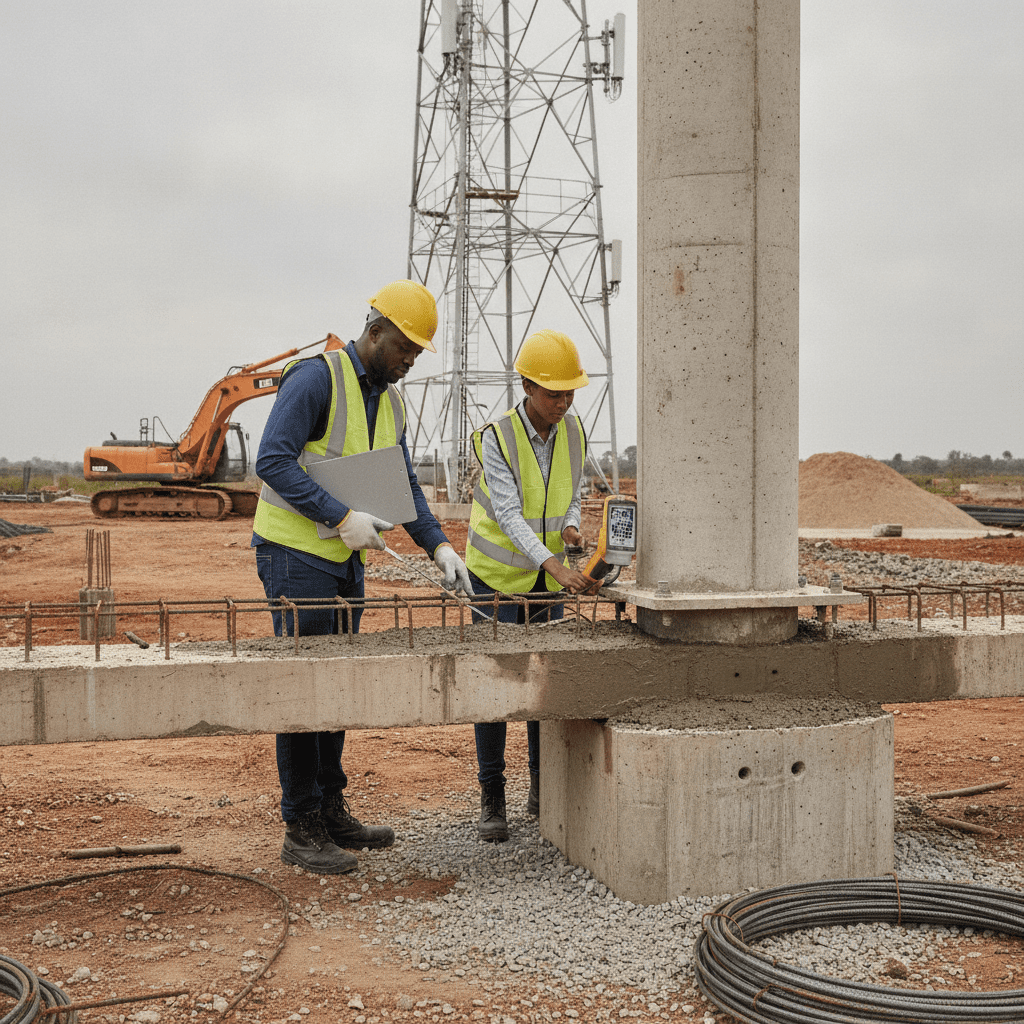
Geotechnical Investigation and Structural Design Process for Telecom Towers
| Common Oversight | Recommended Practice |
|---|---|
| Assuming uniform soil conditions across the site without adequate investigation. | Conduct comprehensive geotechnical investigations, including boreholes and lab tests, at specified locations. |
| Underestimating wind loads or using generic wind speed data. | Utilize site-specific wind data and apply relevant Kenyan or international wind load standards for calculation. |
| Neglecting the uplift forces caused by overturning moments. | Design foundations explicitly for uplift resistance, considering dead weight, soil overburden, and anchor systems. |
| Inadequate reinforcement detailing or concrete cover in aggressive environments. | Specify appropriate concrete mix designs, sufficient cover, and corrosion protection for coastal or acidic soils. |
| Ignoring potential for differential settlement on variable ground. | Perform settlement analysis and, if necessary, design deep foundations or ground improvement for expansive/compressible soils. |
| Lack of independent peer review for complex or critical tower designs. | Engage a third-party structural engineer for an independent peer review of all design calculations and drawings. |
Key Factors Influencing Foundation Choice and Regional Considerations
Risks, Compliance, and Contextual Considerations for Telecom Tower Foundations
Geotechnical Variability and Its Impact
Structural Integrity and Environmental Loads
An effective telecom tower foundation design is not solely a geotechnical or structural exercise. It requires an integrated approach that considers telecommunications equipment requirements, access for maintenance, lightning protection, and earthing systems. Coordination among various engineering disciplines ensures a robust, compliant, and operationally efficient solution.
Regulatory Compliance and Approvals
Compliance with Kenyan building codes and county-specific by-laws is non-negotiable for telecom tower foundations. While the Kenya Building Code of 1968 provides a foundational framework, many county governments, such as Nairobi City County and Mombasa County, adopt updated international standards (e.g., Eurocodes, British Standards) for modern construction. The design must be prepared and signed off by a registered professional engineer in good standing with the Engineers Board of Kenya (EBK). This ensures adherence to professional standards and accountability.
The approval process typically involves submitting structural drawings, geotechnical reports, and architectural plans to the relevant county planning department. For larger installations or those in environmentally sensitive areas, an Environmental Impact Assessment (EIA) study and subsequent approval from the National Environment Management Authority (NEMA) may be required. Non-compliance can lead to severe consequences, including stop orders, demolition notices, significant fines, and legal action, all of which result in substantial project delays and increased costs.
Frequently Asked Questions
What is the typical lifespan of a telecom tower foundation in Kenya?
A well-designed and properly constructed telecom tower foundation in Kenya is typically engineered for a service life of 50 to 100 years. This longevity, however, is contingent on several critical factors, including the quality of materials used, adherence to construction specifications, the aggressiveness of the local environment (e.g., coastal corrosion, expansive soils), and the efficacy of ongoing maintenance and inspection programmes. Factors like significant changes in tower loading, severe seismic events, or prolonged exposure to adverse conditions without intervention can shorten this lifespan. Regular structural assessments are recommended to monitor its condition.
How do engineers account for different soil types in Kenya when designing foundations?
Engineers account for Kenya’s diverse soil types through a rigorous site-specific geotechnical investigation. For expansive black cotton soils, designs often incorporate under-reamed piles or raft foundations with a deep excavation backfilled with non-expansive material to isolate the foundation from soil movement. In stable murram or lateritic soils, shallow spread footings or raft foundations may be suitable, provided bearing capacity is adequate. For sandy soils in coastal areas or riverine plains, deep foundations such as driven piles or bored piles are frequently employed, with careful consideration of groundwater levels and potential for liquefaction. Soil improvement techniques may also be implemented where ground conditions are marginal.
What permits and approvals are necessary for constructing a telecom tower foundation in Kenya?
Constructing a telecom tower foundation in Kenya requires several key permits and approvals. Primarily, a building permit must be obtained from the respective County Government’s planning department (e.g., Nairobi City County, Mombasa County). This process involves submitting detailed structural drawings, a comprehensive geotechnical report, and site plans, all endorsed by a registered professional engineer. Depending on the project’s scale and location, an Environmental Impact Assessment (EIA) report might be required by the National Environment Management Authority (NEMA). Additionally, land use change approvals may be necessary if the proposed site’s current zoning does not permit such structures. Adherence to these regulatory steps is crucial to avoid legal complications and project halts.
What are the critical factors for ensuring the long-term stability of a tower foundation?
Ensuring the long-term stability of a telecom tower foundation hinges on several critical factors. Firstly, a thorough geotechnical investigation provides accurate soil parameters, enabling a safe and efficient design. Secondly, the structural design must rigorously account for all anticipated loads, including dead, live, wind, and seismic forces, with adequate factors of safety. Thirdly, quality control during construction, including proper material selection, concrete mix design, and strict adherence to specifications, is paramount. Finally, effective site drainage around the foundation prevents water accumulation and potential erosion or saturation of bearing soils. Regular inspections and maintenance also play a vital role in identifying and addressing any issues before they compromise stability.
Key Takeaways
The successful and safe deployment of telecom towers and masts across Kenya hinges on a rigorous, integrated approach to foundation design. From the initial geotechnical investigation to the final structural detailing, every phase demands precision and adherence to engineering best practices. Understanding the unique challenges presented by Kenya’s diverse geological landscape and climatic conditions is not merely advantageous but essential for ensuring the long-term stability and operational integrity of these critical infrastructure assets.
- Comprehensive Geotechnical Investigation: A detailed site-specific geotechnical study is the absolute bedrock of any telecom tower foundation design. This includes boreholes, CPTs, and laboratory tests to accurately classify soil types, determine bearing capacity, assess settlement potential, and identify problematic soils like expansive black cotton or corrosive coastal sands.
- Site-Specific Foundation Selection: The choice of foundation type (e.g., shallow pad, raft, piled, or rock anchor) must directly correlate with the geotechnical findings, anticipated loads, and site constraints. Generic solutions often lead to over-design or, critically, under-design, risking structural instability.
- Critical Load Considerations: Telecom tower foundations must be designed to resist not only dead and live loads but, predominantly, significant wind loads and potential seismic forces. Overturning moments and uplift forces are often the governing factors, requiring robust anchorage and adequate embedment depth.
- Integrated Structural-Geotechnical Design: Effective foundation design necessitates seamless collaboration between geotechnical and structural engineers. The structural engineer relies on precise geotechnical parameters, while the geotechnical engineer provides recommendations that are structurally feasible and cost-effective.
- Quality Control and Construction Supervision: Even the most meticulously designed foundation can fail without stringent quality control during construction. This includes verifying excavation depths, concrete mix designs, reinforcement placement, and proper compaction of backfill materials. Regular site visits by qualified engineers are indispensable.
- Addressing Local Environmental Factors: Kenyan conditions, such as high water tables in flood-prone areas like Kisumu, expansive soils in parts of Nairobi and Kajiado, or corrosive environments along the Mombasa coast, demand specific design adaptations and material specifications to ensure durability and prevent premature degradation.
- Regulatory Compliance and Safety: All foundation designs must comply with relevant Kenyan building codes, engineering standards, and local authority requirements. Prioritising safety in design ensures the protection of the asset, personnel, and surrounding communities.
- Long-Term Performance and Maintenance: A well-designed foundation is a long-term asset. Consideration of drainage, erosion control, and access for future inspections and maintenance should be incorporated into the initial design to promote longevity and minimise operational risks.
For expert guidance on geotechnical investigations, structural design, and comprehensive engineering solutions for telecom tower and mast foundations in Kenya, connect with qualified professionals.
Phone: +254 719 532 233
Email: info@Cadreatech.com
Website: Cadreatech.com
