
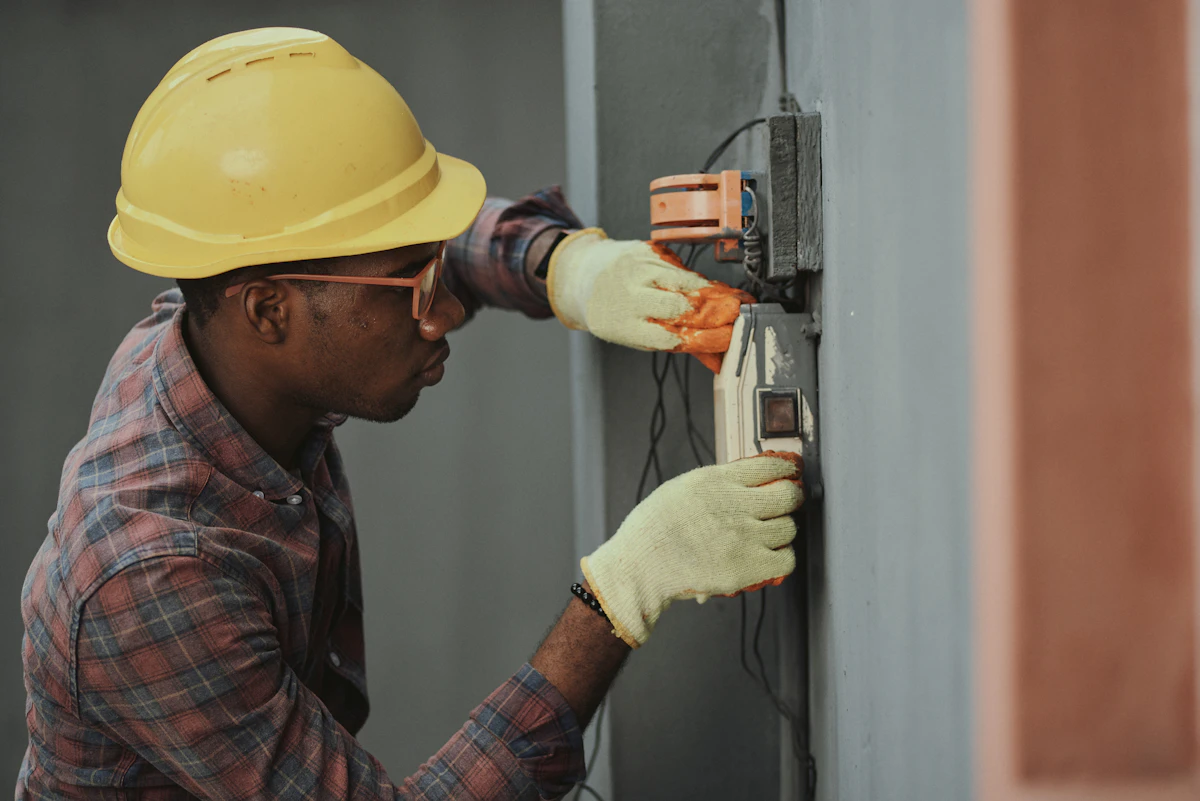
MEP systems — electrical, mechanical, and plumbing installations are the hidden infrastructure that makes every building function. Photo: Unsplash
MEP systems — Mechanical, Electrical, and Plumbing — are the veins of any building. They are also the most underestimated cost in a Kenyan construction budget. Get the numbers wrong at the start, and you pay far more at the end.
Most people picture concrete, steel, and bricks when they think about construction costs. That is the visible skeleton. But what makes that skeleton actually function? Pipes carry clean water and remove waste. Cables distribute power to every room. Ventilation keeps the air fresh. Mechanical systems control comfort and safety. All of that costs money — serious money.
These are MEP systems. Industry data from hundreds of Kenyan building projects shows that MEP costs account for 10% to 14% of total construction expenditure. In commercial or institutional buildings, that figure climbs even higher.
On a KES 10 million residential project, that is KES 1 million to KES 1.4 million for MEP alone. On a KES 50 million commercial development, you could spend KES 7 million or more — before selecting a single fixture.
At Cadreatech, our MEP cost estimation service ensures you know that number accurately — before construction starts, not after.
What Is MEP Cost Estimation?
MEP cost estimation is the process of quantifying and pricing all mechanical, electrical, and plumbing works for a building project. Engineers carry it out during the pre-contract stage — before tender documents go out. It forms a critical part of the Bill of Quantities (BoQ) that governs procurement and cost control throughout the project.
A proper MEP estimate is not a rough percentage applied to the structural cost. Instead, it is an itemised breakdown of every system, every fitting, and every metre of pipe or cable. Engineers price each item at current market rates. They also add allowances for installation labour, testing, commissioning, and long-term maintenance.
MEP covers three distinct engineering disciplines:
- Mechanical (M): HVAC, extraction fans, ductwork, fire suppression systems, and equipment-driven environmental controls.
- Electrical (E): Power distribution, lighting, earthing, switchboards, fire alarms, security systems, and data cabling.
- Plumbing (P): Cold and hot water supply, drainage, rainwater harvesting, sanitary fittings, water tanks, and sump pumps.
Each discipline requires specialist knowledge to price correctly. As a result, a contractor applying a blanket percentage to MEP works is one of the costliest mistakes in Kenyan construction.
Why MEP Costs Are So Frequently Underestimated in Kenya
The pattern is familiar to every engineer and quantity surveyor in Kenya. A client commissions architectural and structural drawings and gets a structural BoQ prepared. They feel confident in their budget. Then the MEP contractor submits a quote. Suddenly, the budget is short by 20% or more.
This happens for four predictable reasons.
1. MEP Is Treated as an Afterthought
In many Kenyan residential projects, clients hand MEP responsibilities to the contractor only after the structural frame is complete. When engineers do not integrate MEP into the design from the start, contractors must partially demolish or modify the structure to fit pipes, ducts, and conduits. That remedial work costs extra — every time.
2. Equipment Costs Are Volatile
MEP relies heavily on imported equipment — switchgear, pump sets, HVAC units, and specialist fittings. Kenya’s 2025 construction costs rose by 12% on average, largely due to currency volatility and global supply chain pressure. Therefore, an estimate from eighteen months ago will almost certainly be wrong today.
3. Testing and Commissioning Are Left Out
Many preliminary MEP estimates cover supply and installation. However, they omit testing, commissioning, and handover documentation. In regulated buildings — hospitals, commercial kitchens, or any project needing a certificate of occupancy — commissioning is not optional. It can add 3% to 8% to the total MEP contract value.
4. Maintenance Requirements Are Ignored
A complete MEP estimate must include projected maintenance costs. For example, a cheap pump requiring monthly servicing costs more over five years than a premium pump needing only annual attention. Consequently, good MEP estimation uses life-cycle costing — not just the cheapest upfront price.
⚠ Key fact: MEP systems account for 10–14% of total construction costs in Kenya. Yet most early-stage budgets omit or underestimate them entirely. On a KES 20 million build, that is a KES 2–2.8 million gap — enough to derail your project.
What Cadreatech’s MEP Cost Estimation Service Covers
Cadreatech prepares detailed, itemised MEP Bills of Quantities, cost estimates, equipment schedules, tender documentation, and material take-offs. We serve residential, commercial, institutional, and mixed-use projects across Kenya.
Furthermore, our MEP estimation integrates directly with our architectural design and structural engineering outputs. This means the estimate reflects actual approved drawings — not generic assumptions.
Equipment Cost Evaluation
We evaluate capital costs for all MEP equipment against current pricing from verified Kenyan suppliers and approved importers. This covers HVAC units, pump sets, generators, switchgear, water tanks, sanitary fixtures, and all ancillary components. We specify equipment at a level that supports direct market comparison and competitive tendering.
Installation Labour Rates
We benchmark our labour rates against current market rates for electricians, plumbers, HVAC technicians, and specialist subcontractors in Nairobi and other Kenyan urban centres. In addition, we account for regional labour rate differences and flag where specialist imported labour may apply.
Testing and Commissioning
All MEP systems require testing before handover. Our estimates include pressure testing for plumbing, continuity and insulation resistance testing for electrical installations, and functional testing for HVAC systems. We also include the preparation of as-installed record drawings and commissioning certificates — as explicit line items, not buried in contingency.
Maintenance Schedules and Operational Cost Projections
We evaluate the long-term operational cost of MEP systems during the specification process. As a result, clients make procurement decisions based on total cost of ownership — not just the cheapest upfront price.
Tender Documentation
We prepare complete MEP tender packages — Bills of Quantities, specifications, equipment schedules, and tender drawings. Consequently, clients receive genuine like-for-like quotations from MEP contractors, which makes evaluation straightforward and fair.
MEP Cost Benchmarks for Kenya in 2026
The table below provides a starting-point budget orientation. It draws on current market data and IQSK (Institute of Quantity Surveyors of Kenya) cost guidance for 2025/2026.
| Building Type | Total Cost Range (per m²) | Estimated MEP Portion (10–14%) |
|---|---|---|
| Standard residential bungalow | KES 54,730 – 65,000 | KES 5,473 – 9,100 per m² |
| Mid-class maisonette | KES 65,000 – 80,000 | KES 6,500 – 11,200 per m² |
| Low-rise apartment block | KES 70,000 – 90,000 | KES 7,000 – 12,600 per m² |
| Commercial office (low-rise) | KES 75,830 – 100,000 | KES 7,583 – 14,000 per m² |
| Commercial office (high-rise) | KES 100,000 – 136,390 | KES 10,000 – 19,095 per m² |
Cost figures sourced from INTEGRUM’s 2025 Kenya Construction Costs Report. MEP percentages are based on IQSK elemental cost data and Cadreatech project experience.
Note that these are benchmark figures only. A 100m² home and a 100m² commercial kitchen share the same floor area but have completely different MEP systems. Occupancy type, service requirements, and specification standard all drive the final number. Therefore, always commission a project-specific estimate.
The Consequences of Getting MEP Estimation Wrong
Underestimating MEP costs is not just a financial inconvenience. It directly affects project delivery, building quality, and in some cases, occupant safety.
Budget Shortfalls Mid-Construction
The most common consequence is a cashflow crisis during construction. Structural and architectural works proceed on budget. Then MEP contracts arrive, and the client runs out of money before the building becomes functional. The result is a structurally complete shell — no power, no water, no ventilation — sitting idle while the client arranges emergency financing.
Specification Downgrade
When MEP budgets run short, the temptation is to downgrade specifications mid-project. Smaller cable sizes, cheaper pumps, reduced HVAC capacity — these all seem like quick savings. However, they create safety, compliance, and operational problems that last for decades.
Non-Compliant Installations
Kenya’s building codes — enforced by the National Construction Authority (NCA) and county governments — set minimum standards for MEP installations. Non-compliant electrical wiring is a leading cause of building fires in Kenya. Getting MEP right from the estimate stage is how you ensure the finished building meets those standards.
Contractor Disputes
Without a detailed MEP BoQ, scope disputes between client and contractor are almost inevitable. One contractor includes an item; another excludes it. Without an agreed schedule of quantities, the only resolution is costly variation orders. A properly prepared MEP estimate prevents these disputes before they start.
MEP Cost Estimation for Diaspora Clients Building in Kenya
Are you a Kenyan living in the UK, US, Australia, Canada, or UAE and building back home? If so, MEP cost estimation is one of the most important services you need — and one of the most commonly skipped.
The reason is simple. When you are not on the ground, you depend entirely on your contractor’s word. Some contractors quote low on MEP to win the job. They then raise variations throughout the project. This is one of the most common ways diaspora clients lose money on Kenyan construction projects.
Cadreatech gives you an independent, professionally prepared benchmark. You know what MEP should cost before you receive a single contractor quote. That knowledge protects you. Moreover, combined with our remote construction supervision service, you get the same financial and technical control that an on-site client would have.
✔ Cadreatech’s approach: We prepare MEP Bills of Quantities, equipment schedules, and tender documentation as part of an integrated package — architectural, structural, MEP, and QS, all under one roof. One firm. One consistent set of drawings. One submission package.
How MEP Estimation Fits Into the Broader Construction Process
MEP cost estimation must connect with all other disciplines from the earliest design stage. MEP systems need physical space — in floors, ceilings, walls, and risers. If the structural engineer designs slabs without input from the MEP engineer, contractors must cut penetrations through finished concrete. Ceiling heights shrink to fit unexpected ductwork. Both outcomes cost money that good coordination would have avoided.
At Cadreatech, our MEP cost estimation works directly alongside:
- Our architectural drawings — so MEP routes, riser locations, and service zones are part of the design, not added later
- Our structural drawings — so slab penetrations, duct openings, and equipment loadings appear in the structural design from day one
- Our full Bill of Quantities — so MEP costs integrate into the master project budget with no surprises
Frequently Asked Questions on MEP Cost Estimation in Kenya
What percentage of my total build cost should I budget for MEP?
For standard residential construction in Kenya, budget between 10% and 14% of total construction cost. For commercial, institutional, or high-specification projects, this figure rises to 18% or more. In all cases, a project-specific estimate is more reliable than any benchmark percentage.
When should I commission an MEP estimate?
Commission it as early as possible — ideally at concept design stage. At the very latest, commission it before issuing tender documents. If you wait until contractors have already quoted, you evaluate those quotes without an independent benchmark. That weakens your position significantly.
Can I use a general quantity surveyor for MEP estimation?
Yes — a BORAQS-registered quantity surveyor can prepare MEP Bills of Quantities. However, accuracy depends on access to detailed MEP drawings and current market rates. At Cadreatech, QS and MEP engineering work together in-house. As a result, every estimate is grounded in actual engineering design — not assumptions.
How does MEP cost estimation improve contractor selection?
A detailed MEP BoQ is the most effective tool for fair contractor selection. When every contractor prices the same itemised schedule, you compare quotes on a true like-for-like basis. Without it, the lowest quote is often simply the most incomplete one.
Ready to Get an Accurate MEP Cost Estimate for Your Project?
Whether you are planning a family home in Nairobi, an apartment block in Kiambu, a commercial development on the coast, or a diaspora build from abroad — Cadreatech can help. We prepare detailed, professional MEP cost estimates as part of a full project consultancy package.
Our fee is 5% of total project cost. That covers architectural, structural, MEP, and quantity surveying services. In other words, 5% protects the other 95% of your investment. That is not an expense. That is protection.
Talk to a Cadreatech Engineer Today
Get a free initial consultation on your MEP budget and full project cost estimate.
📞 0719 532 233 | 🌐 cadreatech.com
📍 Piedmont Plaza, Ngong Road, Nairobi | ✉ info@cadreatech.com
