
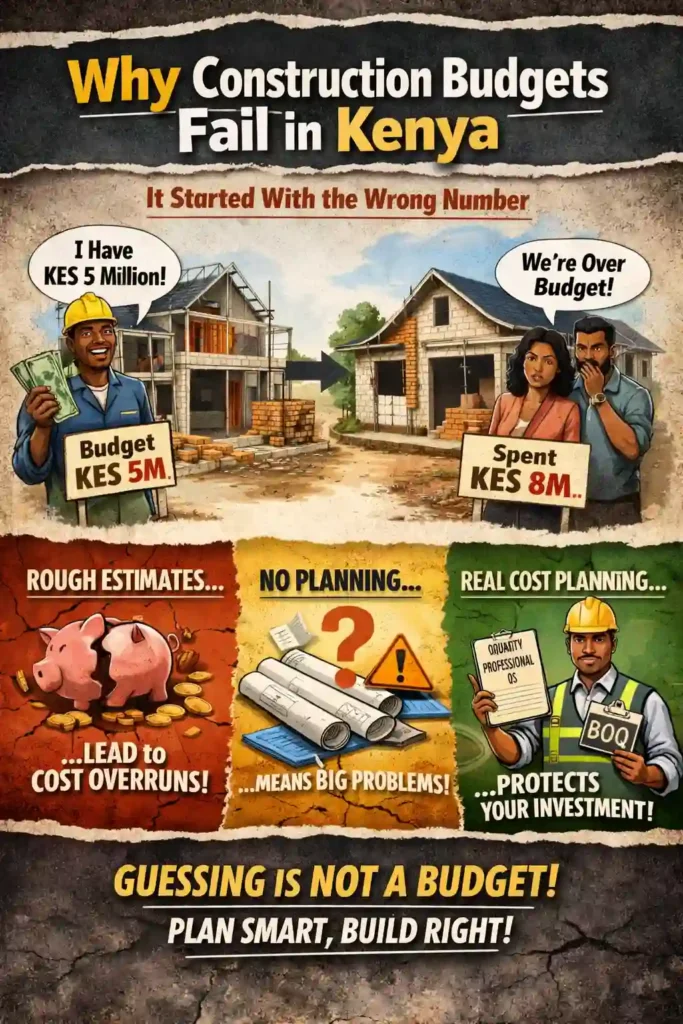
Many construction projects in Kenya don’t technically go over budget.
The uncomfortable truth is simpler.
The budget was wrong from the beginning.
A client starts a project thinking it will cost.
Halfway through construction they have already spent — and the house still isn’t complete.
The first reaction is usually:
“My contractor went over budget.”
But in most cases, the problem started long before the first slab was poured.
It started during planning.
In this article, we break down why construction budgets fail in Kenya and how proper cost planning can protect your investment.
The Dangerous Way Most Construction Budgets Start
Many projects begin with statements like:
- “I have M.”
- “My friend built with M.”
- “The contractor said it should be around M.”
Unfortunately, construction doesn’t respond to:
- Hope
- Comparisons
- Vibes
- WhatsApp estimates
Construction responds to technical realities, including:
- Project scope
- Market material rates
- Quality of finishes
- Location of the site
- Structural requirements
- Design complexity
Budget failure usually begins when the project starts without proper planning tools, such as:
- Detailed architectural drawings
- Structural engineering design
- Soil investigation report
- Bills of Quantities (BOQ)
- Professional cost planning
Without these, any number given is simply a guess.
If you’re planning a project, it’s important to understand the difference between a guess and a budget.
You can also explore our guide on Quantity Surveying Services to understand how professional cost planning works.
Estimates vs Budgets vs Final Cost
Many clients confuse these three terms, but they are very different.
Understanding the difference is the first step toward avoiding cost overruns.
1. Construction Estimate
An estimate is an early-stage approximation.
Think of it like guessing how much your shopping will cost before entering the supermarket.
Estimates are usually based on average construction cost per square metre.
For example, someone might say:
“Construction is about.”
But this approach has a large accuracy margin of ±20–30%.
Estimates are useful for feasibility thinking, but they should never be treated as fixed budgets.
Unfortunately, many clients mistake estimates for final costs.
This is where problems begin.
2. The Real Construction Budget
A proper budget is engineered, not guessed.
It is developed using technical documentation such as:
- Architectural drawings
- Structural design
- Mechanical, Electrical, and Plumbing (MEP) design
- Bills of Quantities (BOQ)
- Current market material prices
A realistic construction budget also includes:
- Contingency allowances (usually 5–10%)
- Professional consultancy fees
- County approvals and permits
- Utility connections
A properly developed budget answers one important question:
“What will this project realistically cost?”
For an overview of how construction costs are calculated globally, see the Royal Institution of Chartered Surveyors guidelines on cost planning.
3. Final Project Cost
The final cost is what the client eventually pays after:
- Variations
- Design changes
- Inflation
- Delays
- Rework
- Exchange rate fluctuations (for imported materials)
Even well-managed projects experience some variation.
However, a properly planned project keeps this variation predictable and controlled.
The biggest mistake clients make is treating rough estimates as final budgets.
Why Rough Construction Figures Are Dangerous
“Rough figures” often create false confidence.
Someone tells you:
“The house should cost about 3M.”
Later the project reaches , and the client feels cheated.
But the original number ignored several critical factors.
Ballpark figures usually ignore:
- Soil conditions
- Structural load requirements
- Architectural finishes
- Mechanical and electrical services
- Site access challenges
- Transport logistics
- Market price fluctuations
These variables can dramatically affect the final project cost.
Example: Same House, Different Cost
Consider a 150 square metre bungalow.
The size may remain the same, but the cost can vary dramatically.
Finishes
Basic finishes might cost X.
Premium finishes can increase the cost by 30–40%.
Same house. Very different budget.
Soil Conditions
Soil conditions can significantly affect foundation costs.
| Soil Type | Relative Cost | Reason |
|---|---|---|
| Soft Soil | X | Easy excavation |
| Soft Rock | 2–3X | Harder excavation |
| Hard Rock | 4–8X | Drilling or blasting required |
Without a soil test, foundation costs become unpredictable.
The International Society for Soil Mechanics and Geotechnical Engineering explains how soil conditions influence structural design worldwide.
Location Matters
If a house in Nairobi costs X, the same house upcountry might show:
- 10–20% higher material transport costs
- 20–40% lower labour costs
The final difference may still result in 5–15% lower overall construction cost.
Location affects:
- Material delivery
- Labour availability
- Equipment access
- Contractor logistics
Market Price Volatility
Construction markets are not static.
Material prices fluctuate.
Recent studies show annual construction cost volatility ranging between 8% and 25% depending on economic conditions.
Steel, cement, and imported fittings are particularly sensitive to exchange rate changes.
This is why budgets must include contingencies.
The Role of the Quantity Surveyor (QS)
A Quantity Surveyor is essentially the financial strategist of a construction project.
If an architect designs the building and an engineer ensures it stands safely, the QS ensures the project remains financially realistic.
In simple terms:
A Quantity Surveyor translates drawings into money.
They help clients:
- Understand the true cost of the project
- Identify cost-saving options
- Plan project cash flow
- Avoid unexpected financial shocks
You can learn more about professional cost management through our Quantity Surveying services
What a QS Actually Does
A Quantity Surveyor performs several critical functions.
They:
- Convert designs into cost intelligence
- Test alternative material options
- Align scope with the client’s financial capacity
- Develop cashflow projections
- Prepare tender documentation
- Evaluate contractor bids
- Monitor costs during construction
- Certify contractor payments
- Control project variations
Without a QS involved:
- Contractors may price emotionally
- Clients approve payments blindly
- Costs drift without proper control
That is why many professionals say:
A QS does not make projects expensive.
They stop projects from becoming expensive by mistake.
Scope Creep: The Silent Budget Killer
Many projects start with a clear plan.
But as construction progresses, the scope quietly grows.
For example:
You start with a 3-bedroom house.
Then you add:
- A bigger kitchen
- Gypsum ceilings
- Larger windows
- A DSQ
- A perimeter wall
- Cabro driveway
- Solar installation
- Borehole drilling
Each change feels small.
But together they destroy the budget.
The truth is:
Your budget didn’t fail.
Your scope grew silently.
Scope creep is usually client-driven, not contractor-driven.
Examples include:
- Upgrading tiles mid-project
- Enlarging windows
- Adding balconies
- Introducing gypsum ceilings
- Adding landscaping late
- Installing solar halfway through construction
Each change affects:
- Structural design
- Mechanical and electrical systems
- Finishes
- Approvals
- Construction timeline
Financially, these changes can increase costs by 15–25% of the project value.
Design Decisions Are Cost Decisions
Clients often approve beautiful designs from Pinterest or Instagram without understanding their cost implications.
But every design choice affects the budget.
For example:
| Item | Lower Cost Option | Higher Cost Option | Cost Increase |
|---|---|---|---|
| Tiles | Basic ceramic | Premium porcelain | +20–80% |
| Windows | Aluminium | Steel | +50–80% |
| Wall Finish | Paint | Natural stone cladding | +70–200% |
| Fittings | Local brands | Imported fittings | +30–120% |
Materials influence:
- Initial construction cost
- Installation cost
- Maintenance requirements
- Replacement cycles
This is why design decisions must always be made alongside cost planning.
Hidden Construction Costs Many Clients Forget
Another common reason budgets fail is hidden project costs.
Clients often focus only on the building structure.
But several other expenses exist around the house.
These include:
- County approvals and permits
- Soil testing
- Utility connections (water, electricity, sewer)
- Perimeter walls and gates
- Drainage works
- Driveways and landscaping
- Professional consultancy fees
- Inflation adjustments
It is common for a house estimated at to require for external works and approvals.
True cost control happens before construction begins, during:
- Design development
- Scope definition
- Professional engagement
Trying to control costs during construction is often too late.
The Real Lesson: Planning Protects Your Budget
Most construction budgets fail before construction begins.
Not because of dishonest contractors.
Not because of bad luck.
But because the planning stage was too shallow.
Good cost planning is not about making projects cheap.
It is about making them predictable.
If you are planning to build in Kenya, the smartest investment you can make is engaging professionals early.
This includes:
- Proper architectural and structural design
- Professional quantity surveying
- Detailed cost planning
- Clear scope definition
If you would like professional support, explore our full range of engineering and construction consultancy services.
Final Takeaway
Your project did not go over budget.
Your budget was never realistic.
Ballpark figures are how construction budgets get destroyed.
Design decisions are cost decisions.
And a Quantity Surveyor is not an expense.
They are your budget’s bodyguard.
